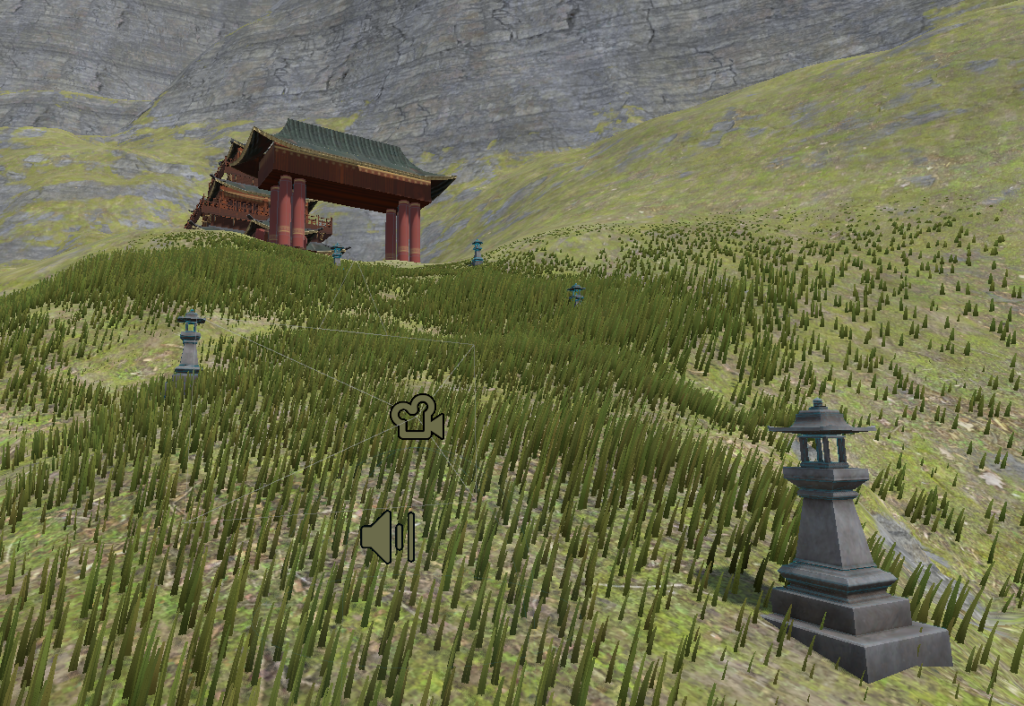
Got some suitable environmental objects imported and scaled appropriately, rebuilding and assigning the materials properly is time consuming, but it’s working. Still Looking for suitable models to represent the collectables, and some fitting materials for the ground.
For my Scavenger Hunt game, my overall design idea is searching for parts to fix up a damaged vehicle. Thinking of using a beat up truck and having the environment being an old junkyard.
Collectables I am considering will fall into a few categories, tools, junk, ‘components’ like battery, tires, sparkplugs etc.
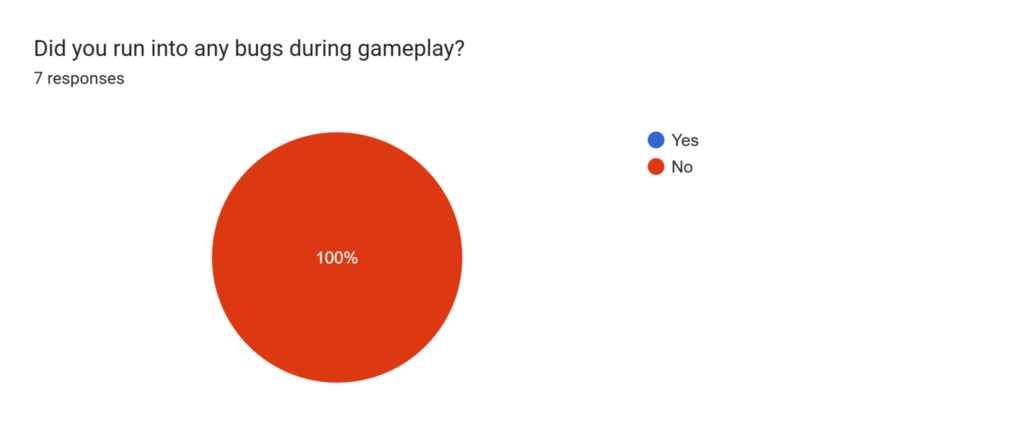
While the majority of players did not encounter any bugs, one did. Involving Google Chrome on MacOS the ground did not properly render. This was a bug I was initially having trouble with on windows. I had fixed the issue, but the problem is a little more complicated, and further digging into it reveals it’s kind of a mixed bag in how WebGL is not exactly a perfectly followed standard across web browsers, or even versions of the same browser across operating systems. Entirely related to the shaders used in mapping the textures to the geometry of the terrain in the Terrain3D plugin I was using for the landmass in the project.
Moving on to performance, all players reported that it performed well. With the majority giving it full marks on performance. This was an area I was concerned about because the machines I develop from are on the higher end more enthusiast class devices. And I hadn’t spent any time testing on weaker hardware to see if there were any performance issues.
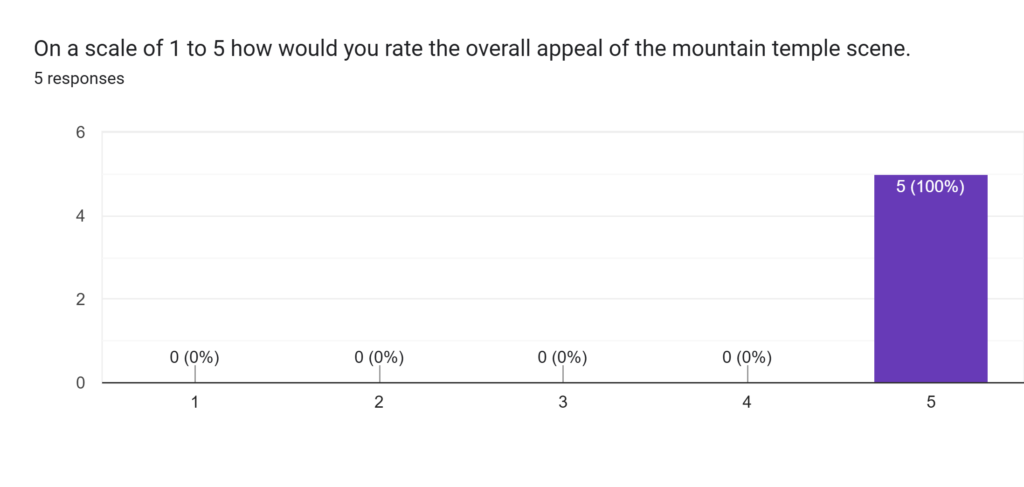
Players reported favorably for the overall appeal of the scene I designed, with every player giving it full marks. This pleases me as there was some additional things I had to cut because of constraints with file size limits on itch.io (200mb individual file limit within the archive)
As for more open-ended feedback from players, they generally enjoyed the theme, atmosphere and music selection. One expressed the desire to enter the temple. (I would have loved to have added that given more time to fully design things myself.) And another expressing that it would be nice to see the foxes roam more freely around the area.
One comment nailed more of my intent expressing that it would be nice to make more use of the surrounding terrain with additional temples and such to explore. And I agree and would have enjoyed adding a lot more to the environment if Godot had a reliable way of exporting the assets into more than a single package file, as that would have given me a little more freedom to add more things.
A final bit of feedback I received about the general premise for the project, and slowing the player down more would fit better. I absolutely agree. And would be something to consider when revisiting this down the line.
Overall, I am pleased with the feedback I received. The mood and feel I was trying to convey was successfully shared with the players who tried it out, and suggestions and feedback were thoughtful and very much in line with the goals I had. It was a good experience and really showed me how quickly a 3d projects size can balloon even with fairly minimal additions and simple geometry. It would still be nice to get feedback from additional players to get their input as well.
Working with the Terrain3D plugin has turned out to be not that bad overall. I am however beginning to feel like I will need to personally model most of what I want to complete my original Idea for this or come out of pocket for some prefabs. So far, I’ve managed to find and implement a small shrine building that vaguely has the visual appeal I am aiming for. Though it simultaneously feels too small and too big at the same time.
This project’s main concept is going to be the exploration of a mountain temple environment.
Pictured above is Cheng’en Temple:
“Cheng’en Temple (承恩寺) is also known as Shangcha Hall meaning Tea Serving Hall. First built in early Ming Dynasty, the temple covers 1250 square meters. The main hall is 13.7 meters wide and 9 meters deep, with its door well preserved but some broken walls. There on the top of the door writes 7 Chinese characters of “Sheng Zhi She Ci Cheng En Si(圣旨敕赐承恩寺)” with clear and complete handwriting nowadays, which is the important proof of that Chengen Temple was once the royal temple under the imperial order.” – excerpt from: https://www.chinadiscovery.com/guizhou/fanjingshan/fanjingshan-temple.html
This kind of remote serene environment feels right for a calmer exploration focused experience, and I like the idea of construction a scene around this idea. To facilitate this idea, I’ve been looking into a terrain plugin called Terrain3D that adds a fairly easy to understand terrain system into Godot that I can use to shape the environment around the temple and achieve the same kind of “cut into the mountain” setup that the Cheng’en Temple has.
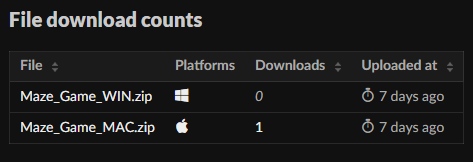
A majority of players reported playing the web version of the game, though there were 3 reports of players playing the Windows or MacOS version, however statistics from itch.io reveals that only one person downloaded either of the native builds. Perhaps I should be clearer in how I ask this question going forward.
Players did not encounter bugs during their time with the game.
Of the seven players, playtime was 2 to 5 minutes in length for the majority, running in line with my overall expectations for length of play with only two outliers.
Difficulty is generally subjective, but most players considered the game as moderate to low difficulty. Two players rated the difficulty as high, one leaving a comment that the player should be able to jump higher, while the other left a comment stating that they enjoyed the game. This highlights the subjective nature of difficulty from user to user, as well as enjoyment is not necessarily dampened by something being considered difficult.
Overall, written feedback was very positive. The new third level went over well with the thin damaged platform paths being an engaging challenge. With one player mentioning they felt like the player slips off a little prematurely but recognizing the player collision mesh having a role in that. This was intentional along with changes to player movement to make the player character feel a little more slippery. A suggestion for increasing the difficulty as the game progresses with moving platforms mentioned as a potential add was made. I agree, and considered the inclusion with this version, absolutely something to consider going forward.
The first level jumping challenge was also praised and requested for that segment to be longer. While I innitially just considered it a mini level to get the player used to how the movement feels and how far you can jump, fleshing the stage out into a longer platforming challenge had not really been considered at the time. The only negative remarks made were in relation to the player’s jump height as mentioned earlier, and one player mentioned the walking sound being a little too loud. I did add a slider to adjust the music volume to the main menu; I’ll consider adding a full volume control to an in-game menu so players can adjust the overall balance if it’s too loud or soft in the future.
Thank you all for playing and filling out the feedback survey! I will take the things I learned here and work them into my future work.
Here is the current state of gameplay in my Maze Game. I have opted to approach this game as a series of levels, rather than one large singular Maze. On level 1 is a simple platforming exercise to force the player into learning how far you can jump, failure leads to restarting the level. Level 2 provides a small platforming space meant to teach the player that jumping as far as possible every time will likely lead to falls, the punishment to failing is climbing back up a ramp to try again. Level 3 Provides a medium sized maze to navigate; there is no failure state with this level, but you can get stuck going in a circle if not carful. While the first level floats in a void with environmental lighting, the subsequent levels both are interior levels with little light, but I have provided the player with a flashlight to help them navigate. In addition to the currently completed levels, a main menu, and ending menu have both been implemented as well as music for both menus and each level.
Music from “M-Drive 16-Bit Music Pack” The music was made by: TobySFWilkinson, I would love to share their work for others interested. However, the website they once held to showcase their work foxaudiocreations.co.uk is apparently down. The itch.io page they hold still exists but unfortunately doesn’t contain much. Snowy Fox – itch.io The only place left that I am aware of that their music can be purchased/licensed through is steam as a DLC for RPG Maker MV and RPG Maker VX Ace, https://store.steampowered.com/search/?developer=FoxAudio%20Creations
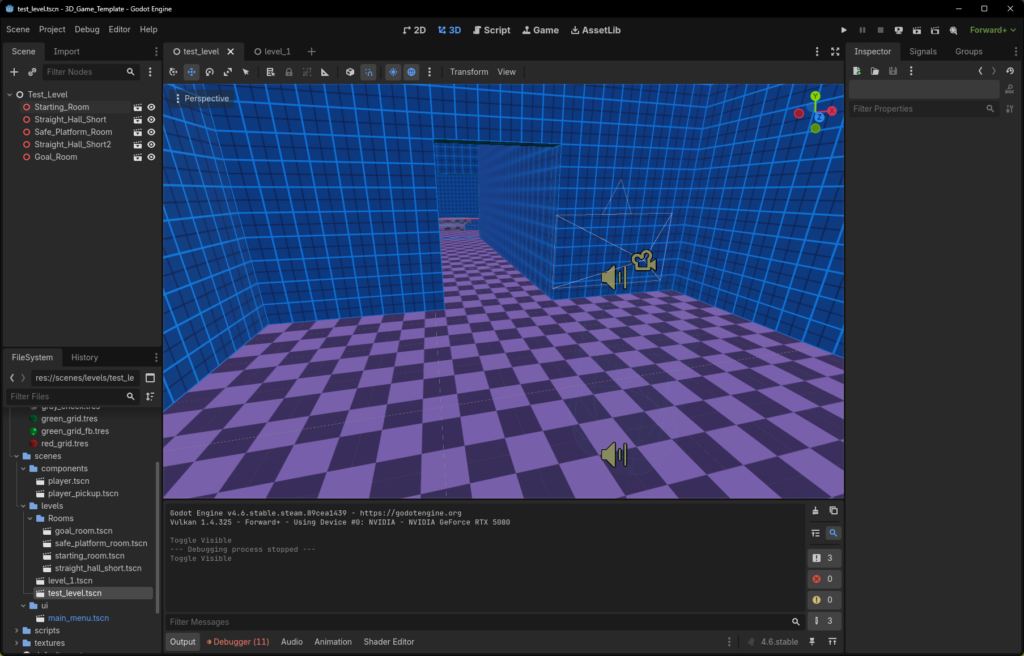
To keep things simple in design, after familiarizing myself with the tools available to construct levels using primitives, My first test design was built to test the limits of a jump from a slightly elevated platform.
From there, I have begun construction of component rooms that can be added and arranged in scenes to construct levels. For now, only a few rooms have been assembled. A “starting room” that contains the player controller, a short hallway, a ‘safe’ platforming room that if you fail to make it across provides a ramp that lets you walk back to the start of the room to try again, and a goal room with a green exclamation point to be used as an end point or transition to the next stage.
I’ve designed a small capsule container consisting of two end caps, and a transparent glass tube. Suspended in the tube is a glowing sphere. The idea was to create a kind of organic/mineral specimen container for use as a background element or key item in a larger overall scene.