Forest Hunt WIP

Small minor updates with level 1, where the trees the user is meant to harvest from are more distinct, and they also change upon fully being harvested.

Other than that, I’m making efforts to add in a cave level where the user can mine for minerals.

Depending on the time I have to work on it, I would like to implement a mechanic wherein the user would use the wood logs to increase the flames in the forge within the cabin, and use the minerals to create a sword.

Scavenger Hunt Concept

For my scavenger hunt process, I decided on a forest where the user would be able to interact with specific trees in order to gather firewood. So far, the interaction aspect is working, save for a few technical issues regarding a few instance(s) sharing their script activations, but it should be resolved soon hopefully.

Other goals include an interior cabin and a pushable door, as well as an interactable sign. Currently there is a grass shader applied to the terrain, as well as a number of different plants and forage, but it doesn’t quite seem “full” just yet, so I plan to add in bushes and more logs to make the scene feel busy.

Ruined City User Testing

Based on the feedback for bugs that I received during testing, most users didn’t have the chance to find collision mishaps due to the sheer size of the game area. A couple users did find a couple instances where the player phased through the collision meshes, something I had noticed only just recently myself.

For testing duration, it seems 66% of testers played for more than 5 minutes, which was, again, more than likely caused by the size of the environment and users exploring.

As for the visuals, color, and environment design, there were mentions of the size, along with the scale of the objects that influenced some of the users to want to explore more. Some noted the colors were one that promoted a more grim and gruesome aspect.

During the sound feedback, there were definitely conflicting answers due to user testing environment, as there were many reports of sound being too quiet, while others noted it being adequate. In the future, adding a volume slider may help as volume testing was mainly done based on my own levels of satisfaction.

Lastly, during additional feedback, some users appreciated and noted the reset button and mentions of the fox howling at their companion. Along with other users mentioning wanting more environmental storytelling and a more concrete path along the area, having more detailed aspects would greatly help the user being invested. In the future, either more NPCs, having certain collectibles, expanding and directing building paths towards a similar goal, as well as providing more visual storytelling are all wonderful things for implementation.

Ruined City WIP

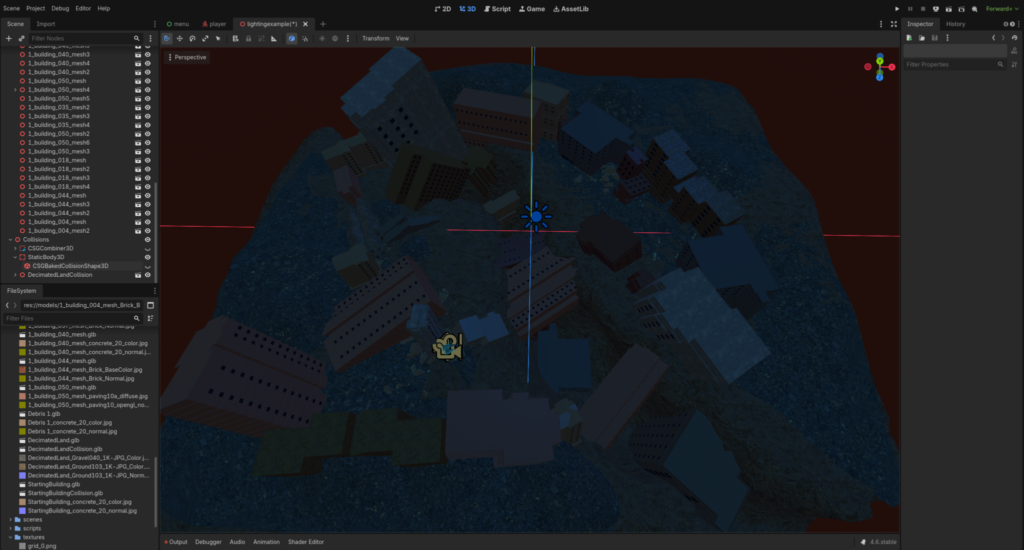
So far I’ve organized the layout of the city using a variety of buildings with debris, and added collision to all objects within the scene. Now, I am in the process of optimizing all the meshes in Blender through dissolving the faces with the aim of reducing the game size. Most textures are used repeatedly within certain buildings, but with how certain meshes have windows in different areas, unfortunately the textures are left being duplicated within Godot.

For reference, all the models and textures inside my folder total up to 90 mbs, and when I’ve exported the project, I end up with 190 mbs total.

Garden Project – Ruined City

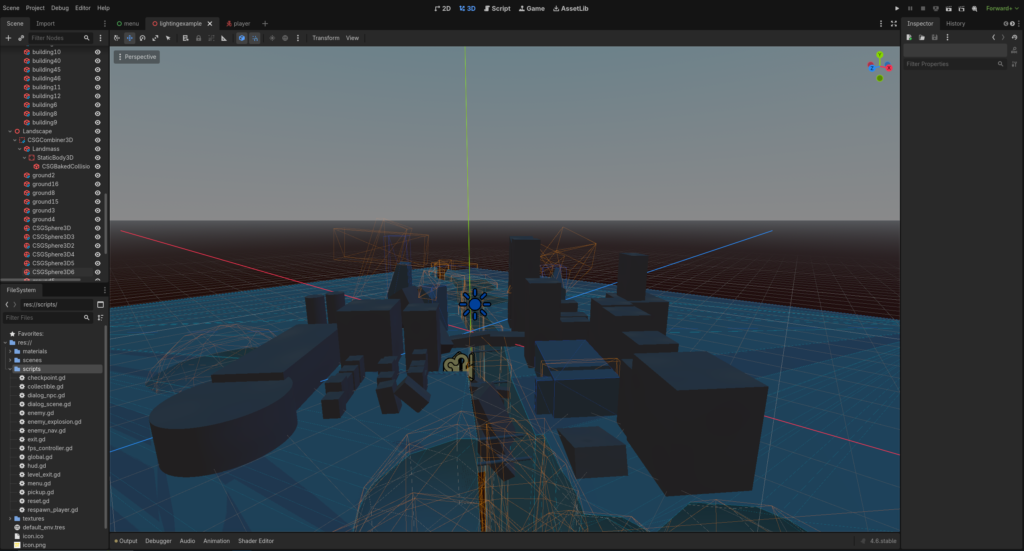
I wanted to create a ruined city environment, one where you’d be able to traverse through the buildings either through staircases, ramps, or bridges that would connect between certain buildings in order to allow the player to experience the scenery. Creating rubble isn’t exactly the easiest in Godot, so for now the buildings are placeholders until I can find a quicker way to demolish buildings, which Blender is much more efficient for.

As for the lighting, I wanted a more subdued sky with cold blue colors and with a tinge of fog in the distance. While the destroyed city reference images I found were influenced by war, the theme I’d like to go for in my environment is one of a natural disaster, which will be shown through craters in the ground.

Ascending the Tower Feedback

It’s interesting to note that some of the feedback contradicts each other wherein some users report that the difficulty of navigating the structure of the tower was just right, and others report it being very difficult. During my initial design process of the level, I had implemented diverging paths that presented differing levels in difficulty, and that may have been the reason for the reports. However, it’s still something to keep in mind that difficulty is subjective.

Other feedback I received tied in with the lighting, particularly as one ascended higher, and that’s something that can be easily remedied. I do note that some platforms can be hard to visually distinguish because of the lighting, and as a result they melt into the shade.

The checkpoint was something I noticed during construction, that it virtually served no real purpose during the second level, and the first level didn’t have many so it needed to be done in one go. Considering the completion rate, adding another checkpoint halfway through the first level can definitely help with concerns about difficulty.

An alternative method can be to move the second level and checkpoint so that there is a hole in the ground below, cementing the need for a checkpoint, but would also increase the tension.

Maze Video

The windows were initially put in for aesthetic (via CSG operations), but down the line I could imagine a scenario where there would either be an alternate path up along the side of the current tower, or a path towards a separate tower altogether. Currently, there is a prospected second level, but it is unfinished.

Maze Level WIP

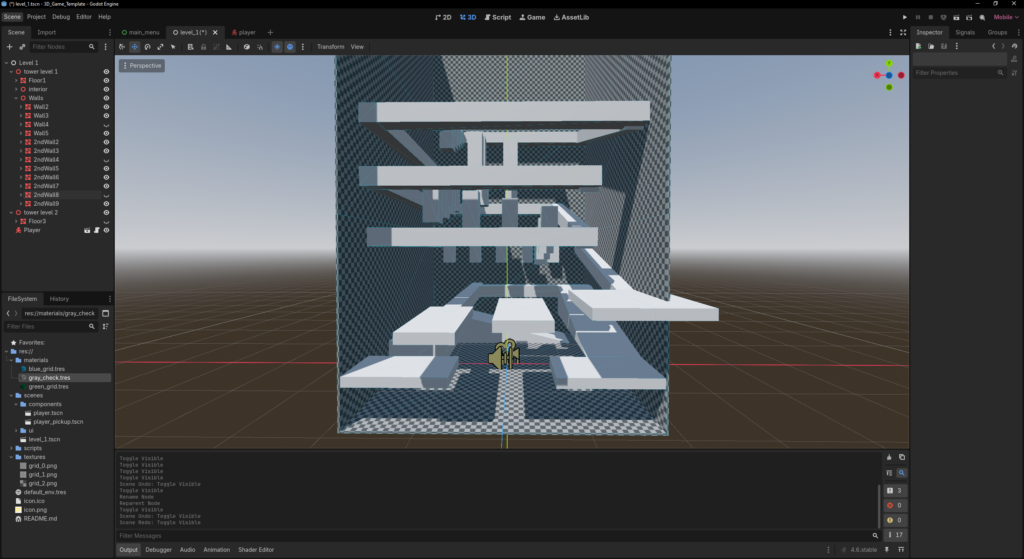
A WIP of the current design for the Maze project. The level philosophy mainly stemmed from a mantra of “not frustrating”. In my past, I’ve played a number of games where jump puzzles or platforming challenges seemed to have some unfair element that would frustrate the player, and to me, that left a lasting scar. But, I also wanted to make it still fun and interesting to traverse without being just outright trivial, because there would be no point to doing so. Looking at it now, things might be a tad too tight between platforms and areas, so it might be a good idea to enlarge the space between?

Blender Model

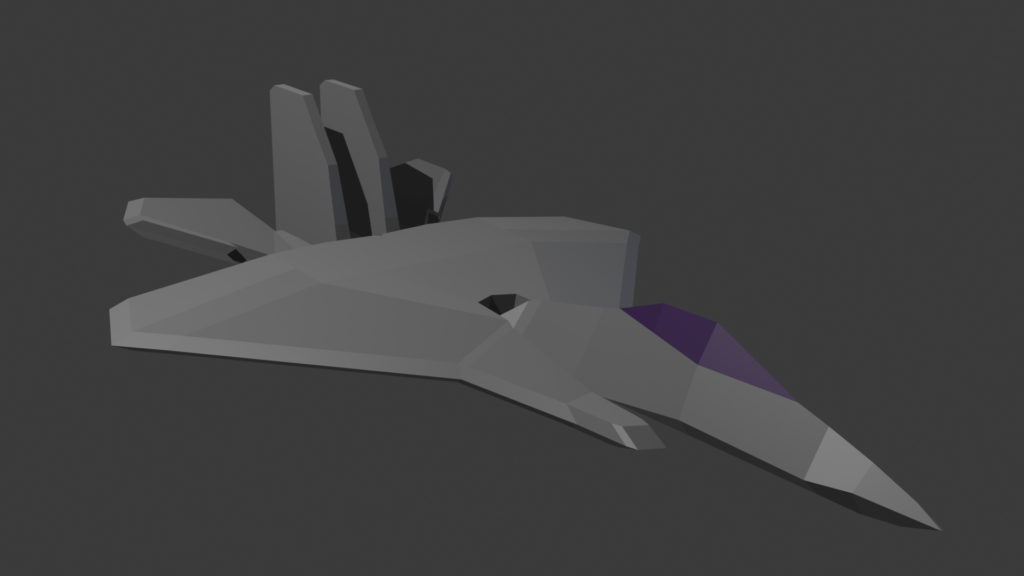
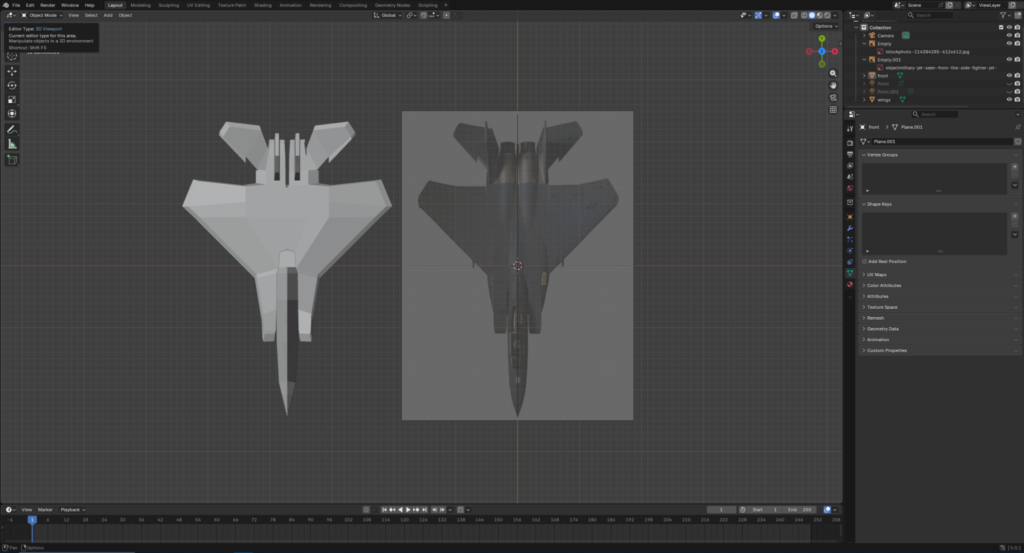
This was an attempt to model a fighter jet while still trying to keep the poly count low. I used images of jets as reference, totaling 320 vertices, 622 edges, and 306 faces. Including the simple materials, it totaled 272 kbs.