
WEEK 3 WORK
MES153 0902: 2/10 – 2/16 | MES153 1000: 2/19 – 2/26
ALL ASSIGNMENTS TO BE COMPLETED BEFORE NEXT CLASS UNLESS OTHERWISE NOTED
NOTE: All links should work on this page and all pages of the OpenLab site. If you find a link not working or otherwise broken, please email me ASAP so it can be fixed ASAP.
 Week 3 Readings
DEVELOPING THE DOC PROJECT DELIVERABLES
All the homework assignments in the first half of the course build toward writing a documentary script package. That’s called theDOC PROJECT and its guidelines here, but in short, what you are in the process of producing are the following:
BASING DOCUMENTARY PROJECT ON LONG NEWS FEATURE APPROVED IN DP1
After you receive a green light on one of your articles, you must study it, reading it in and out to know the entire story. Your script based on the events in the news piece will be shorter than the entire story captured in the article. It will also start differently and unfold differently because you are writing for the screen, writing a script for a movie that would be watched and listened to.
You will build your documentary project over the first six to seven weeks of the course through a series of homework assignments.
One of the first of these is writing a logline which has some more detail below.
You’ll also need to come up with a title for the film. While short, the name of a film is like a calling card for it. It needs to point to the thrust of the story in a short, fitting, clever or otherwise smart and memorable name. Note: The title must be significantly different from the headline or anything else from the original article unless, perhaps, it is something a person in the article said and that short phrase really gets to the heart of the hypothetical documentary.
-
-
LOGLINE
This single sentence must include
The logline should be a single sentence that has been revised several times over the first several weeks of the semester that focuses on the Doc Project.
There are a number of ways to get to a good, strong logline. Below are 12 different ways. Even if one is not exact, it should help you find a way to describe your story through its essential ingredients..


- When an event happens, a person takes action until antagonist threatens.
- After shocking back story happens, a person pursues a difficult goal.
- An interesting person pursues a familiar goal, in an unexpected way.
- Driven by motivation, a person or people pursue a unique goal.
- Special circumstances force a characterto engage in morally ambiguous behavior.
- A group of interesting people face a variety of obstacles as they pursue a collective goal.
- A group of interesting people must choose between their personal needs and the collective good as they face a common enemy.
- An anti-hero makes it his or her mission to rise to power with a certain methodology.
- Two opposite people with limited resourcesmust unite to accomplish a mission.
- A negatively changed world can only be fixed with the accomplishment of an impossible task performed by a unique person.
More on loglines in this video:
https://www.youtube.com/watch?v=bvlWd2tz4xg&t=1s
-
STEP OUTLINE
The step outline is essentially a list of the events/scenes of the script you will write. Note that the description of these events/scenes is a single sentence or phrase.
For a 10-15 minute project there should be between 8 and 25 events/scenes. Each event/scene should illustrate an element of the narrative explicitly.
A good step outline will include all the individual events that will be presented in the ultimate narrative; they may summarize what will be shown but should NOT include specific dialogue or image sequences unless such specificity is necessary to provide clarity of intent.
Read more on step outlines here »
See an example of a step outline here -
TREATMENT
This detailed summary of the film-to-be describes in a moment-to-moment account from fade in to fade out everything that will be seen and heard. Here’s what to remember about writing a treatment:
• You are telling the story thru VISUAL language … that includes all imagery and audio that will eventually end up on video.
• Describe audio and video (NO SCRIPTED DIALOG) – create relationships between these main elements while trying to structure events around protagonist, protagonist want, obstacles (conflict), conflict
• Written in the present tense using some 1st person plural sentences to create scenes – “we see…or we hear…”
• Avoid technical language. Stick to simple descriptive terms that are easily understood, and focus on action and imagery and sounds on screen.
• You are creating a NARRATIVE based on real events, so you are figuring out a beginning, middle and end. Work sequentially.
Read more on treatments here. -
SYNOPSIS
This is a one- to three-paragraph summary that is less specific than a treatment and identifies things that the treatment does not, such as the film’s objective, theme, style, POV, access to sources, audience. Also significantly shorter than a treatment, the synopsis should include all additional info important to the film. (More on the synopsis along with five examples here.)
-
A/V SCRIPT – A two-column script that details what specific video clips and which specific audio parts play when.
-
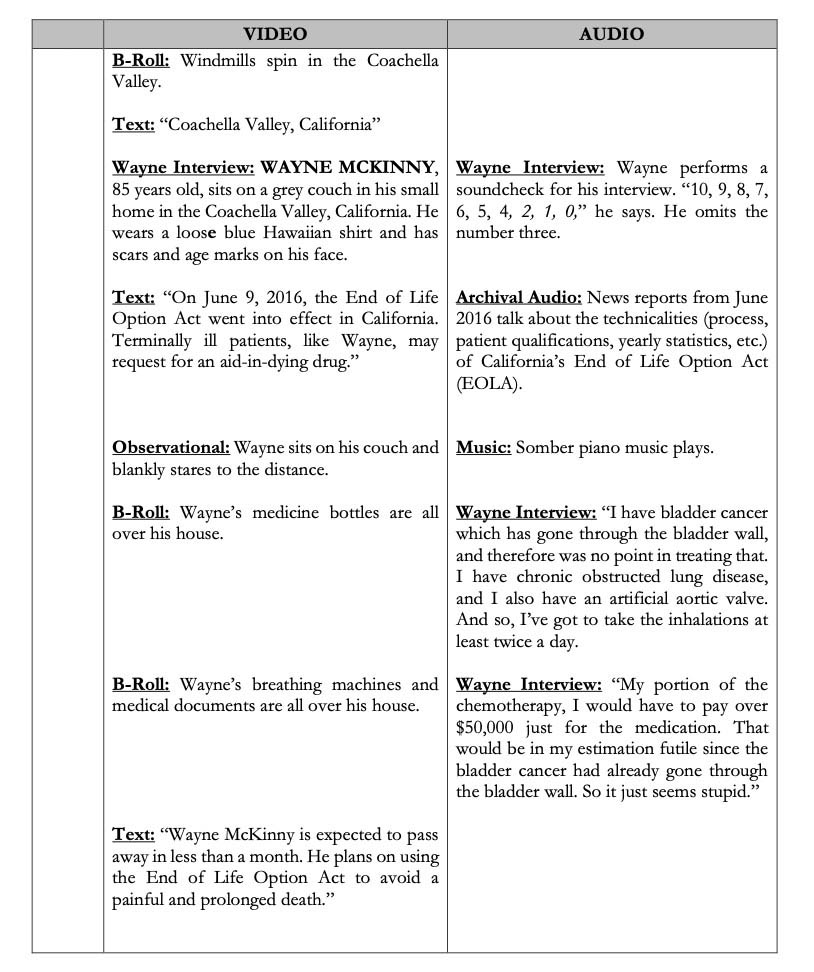
Video overview of an A/V script:
FINDING YOUR STORY’S BEATS
In a documentary script, the scriptwriter has to find the beats around which to build the narrative. But, what is a story beat …?
A beat is a moment in the narrative that propels the story forward and compels the viewer to take stock of what could happen next.
Each scene may be comprised of several different beats. Some story beats are subtle, while others are obvious. A plot is basically a series of dramatically significant moments.
A scene is the basic building block of a screenplay. It’s a unit of dramatic action distinguished by its unity in time and place.
Below are the kinds of beats you should look for in your article to put together a beat sheet and step outline.
- Opening image. A short description of the very first moment or event people will see. Strive for an exciting opening that makes people lean in and sets the tone for the story you’re telling.
- Introduction/Setup and Exposition. One or more beats in which your characters and setting come into clear focus. Who is the main character? What does she want? What is holding her back from getting it?
- Statement of theme. What is your film about? This is the opportunity to show the audience.
- Catalyst/Lock In/Call to Action. This is the moment in which the main character either actively sets out to achieve her goals, or is forced to go down the path plotted for her. Think of the most extreme thing that can happen to your characters, make it happen, and go from there.
- Debate. However, even great characters have their doubts. The main character might need to confer with other characters, or do some soul-searching, before embarking on her journey.
- New characters. As the main character goes through the story, she will likely meet other characters who help or hurt her. This opportunity for one or more new characters, which should come towards the first half of the second act, allows a writer to deepen the conflict and increase tension in the narrative.
- Midpoint. Exactly halfway through your story. The characters have made their decisions, and now reality sets in.
- Low point. Just as the main character seems to be within reach of her goal, something happens that derails her progress or makes her question her journey. A sense of despair or confusion may set in.
- Climax. This is the big moment in which the action spikes and everything that you’ve set up before now comes to a head. In a traditional action film, the climax might be a big chase or fight scene. In short, the climax should show your main character just within reach of her goal.
- Beginning of the end. Once the main character has reached her goal (or come up short), the story begins to wind down. Any secondary storylines should start coming to a close.
- Finale. The final scene viewers will see. This should cap off the theme of the story, and leave your audience with a sense of how your protagonist has grown through the events of the film.
HOW TO CREATE AN OUTLINE
To create an outline, you’ll need to have found the major beats in your article. Remember: the important action of a movie are in the identified beats. You will use those to create scenes in which the action culminates in a beat.
When writing an outline, do NOT number the beats or scenes. Instead, use bullet points or simple line breaks – NOT numbers.
Your aim is to build the script in three acts, so incorporate what has to happen in each act.
ACT 1 Beats (Audio and Visuals)
Describing the AUDIO and VISUALS that would feature in each scene, not simply words that do not have a visual or audio translation, create a short number of scenes that do the following:
- Whose story is it? (What audio and/or visuals can you use to introduce the protagonist?)
- What is the inciting incident that sets the protagonist’s story in motion? (What audio and/or visuals from the article can indicate what launches the protagonist’s journey?)
- What do they want? (What audio and/or visuals can identify the protagonist’s want/desire/goal?)
- What’s stopping them getting it? (What audio and/or visuals can relate the first obstacle your protagonist encounters?)
- What’s at stake?
ACT 2 Beats (Audio and Visuals)
This is where to build a ladder of obstacles (ideally three) for your protagonist to encounter. The ladder here is the rising action — things get progressively more difficult for the main character, climaxing with the most difficult challenge the character encounters.
- Two to four obstacles the protagonist encounters (What audio and/or visuals describe the difficulties your protagonist has while going after his or her goal?)
ACT 3 Beats (Audio and Visuals)
- The biggest challenge your protagonist faces head on (Again, what audio and/or visuals can relate this biggest difficulty in the movie?)
- Whether your protagonist succeeds or fails in his or her goal, show how the story has changed the character (Again, what audio and/or visuals tell this part of the story?)
Week 3 Videos to Watch
“Little Potato” (13:52) | Directed by Wes Hurley and Nathan M. Miller, 2017
Questions for the video:
- Identify the surprise reveals, twists, reversals, and other key beats — important moments — in the story.
- What types of video are used to tell this short doc? (Be as specific as possible.)
- What types of audio are used to tell this short doc? (Be as specific as possible.)
- Who is the protagonist? And how do you know?
- What does the protagonist want?
- Who is/are the antagonist(s)? What are the main obstacles?
- How does the drama build? (What is the rising action? i.e., How do things get progressively difficult for the protagonist?)
Week 3 Homework Assignment (DP3) Instructions
NOTE: Complete all readings before doing this assignment. And for all assignments related to the Doc Project, include a PDF of the article(s) you are basing it on along with links.
This assignment has several parts:
- REVISE YOUR LOGLINE – Rework your logline incorporating in the feedback you received from the professor on Blackboard. You should also use these two logline-writing aids: the digital or hard copy of the logline handout and the All About Loglines page which has examples, videos and requirements for a good logline).
- REVISE THE BEATS FOR YOUR SCRIPT — Beats are the important moments of a story — the actions, events, consequences, etc. that help trace the journey of your protagonist as s/he acts in pursuit of a goal but meets problems along the way.
In trying to find the beats in the written story, look for actions and events that are expressed by a character in the story as well as actions and events that can be visualized. Remember, it’s a movie. Your script and how you tell the story will differ from the reporter’s because one, it will be shorter, and two, it is a visual story. Remember: everything in a movie script must be able to be portrayed on screen.
- WRITE AN OUTLINE – Based on the beats you’ve identified, make a list of scenes described in A SINGLE SENTENCE. Your sentence should relate the main action and/or point of each scene. These should be important moments that propel the story forward to its ultimate conclusion.
Upload your PDF to Brightspace
Section 0902 here » | Section 1000 here »
HOMEWORK 3 TIPs
Things to keep in mind when envisioning the three acts and what should happen in each:
Act I – Open on an important event that describes the and/or profoundly affects the character. This situation should grab the reader/viewer. Open big. Make sure to intro your protagonist, the protagonist’s want, the story setting, the antagonist/conflict — this is the required BIG BUT of the first act.
Act II – Find the difficulties your protagonist encounters — aim for three problems or twists or reveals or a-ha! moments, and structure them in order of least difficult to most challenging.
Act III – This opens on the movie’s dramatic climax (or the setup to it), and is followed by the resolution and denouement.
