AN INTRO TO THE SCRIPT-WRITING PROCESS
The screenwriter does not begin a script by simply coming up with an idea and then sitting down at the computer, opening up her screenwriting software of choice, and beginning to create full scenes.
There is a LOT of prep work involved in screenwriting. An idea for a story is the very tip of the iceberg. To flesh it out, the screenwriter uses a number of development tools explained on this page.
These tools include coming up with a premise, a concept, a logline, beats and beat sheets, outlines, and a treatment. After all this — and more — work is done, the writer will be able to start to craft a first draft.
Writing a story (like a story itself) is a journey. It is a difficult, challenging trek, but the tools writers use en route make it possible, though not inevitable, the writer will find his or her way to the story they want to tell.
PREMISE
The dramatic situation from which the conflict arises and the dramatic action unfolds.
Examples:
- a boy finds companionship in a magical balloon (The Red Balloon)
- a shark torments a beach town (Jaws)
- a man must tell the truth for 24 hours (Liar Liar)
- an ancient mask grants its wearer superpowers (The Mask)
The premise is like a seed. It is a foundational idea that the writer uses to grow and build the story from.
CONCEPT
A concept is a development tool for the writer that encapsulates the basic idea of the film that will help the writer find the beats and create an outline of the story as you’re developing it.
A concept is basically the overall idea for a story (not plot) expressed in a single sentence that includes the protagonist, that character’s main objective, and the main obstacle or obstacles that stand in the way of obtaining that objective.
Example: A boy and the seemingly magical balloon he finds and befriends defy scorn, punishment, even violence to continue their mutual friendship.
To write a concept:
- identify a main character — a brief, concise idea of who the person is, what they do, what makes them tick — and
- identify the character’s main problem and goal
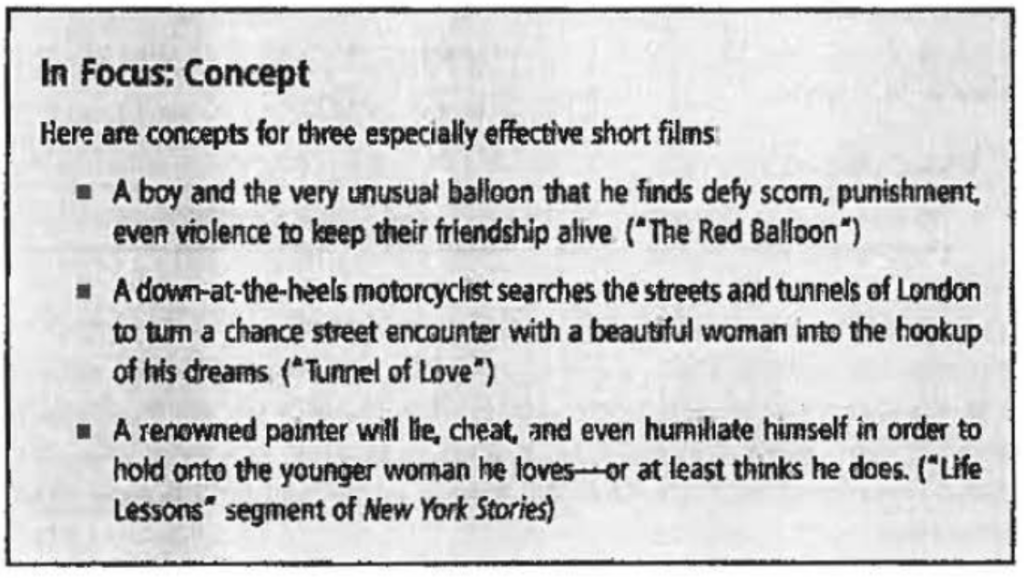
From The Short Screenplay: Your Short Film From Concept to Production, Dan Gurskis, p. 95
SETTING
The world of the movie — specifically time and place. Movies can have more than one setting.
SETTING EXAMPLES
Back to the Future takes place in two settings: Hill Valley, California in 1985 and Hill Valley, California in 1955.
Black Panther takes place in:
Oakland, California, 1992
Present day, Wakanda
Present day, London
Present day, Busan, South Korea
LOGLINES
A script-development tool that translates the 120 pages of action in the screenplay into a single, riveting sentence. A logline is a one-sentence (or two-sentence) summary of the entire story.
All log lines go back to that ancient storyteller’s formula, “What would happen if a character like X ended up in a situation like Y.” Next add a specific catchword that quickly tells the reader what the story is about — is it about love, greed, obsession murder, family turmoil? Once you’re set on one or two words, you can push out from there adding a few more economical adjectives and verbs to make up your long line.
This is the story about _______________________who _________________________.
LOGLINE EXAMPLES
AMERICAN BEAUTY: “The arrival of a troubled family in a small New Jersey suburb collides with their new neighbor’s midlife crisis; the result leads to murder, a frame-up, and two innocents going to prison.”
The official DreamWorks SKG logline for AMERICAN BEAUTY:
“Stuck in a dull life and a loveless marriage, a man stakes out a new direction that ends up costing him his life.”ET: “A meek and alienated little boy finds a stranded extraterrestrial and must find the courage to defy authorities to help the alien return to its home planet.”
GONE WITH THE WIND: “Against the backdrop of the great Civil War, a narcissistic Southern beauty, obsessed with idyllic love, struggles to reconstruct her life and finds her true love is closer than she thinks.”
ROCKY: A boxer (protagonist) with a loser mentality (flaw) is offered a chance by the world champ (opponent) to fight for the title (lifechanging event) but, with the help of his lover (ally) must learn to see himself as a winner before he can step into the ring (battle).
STEEL MAGNOLIAS: An overprotective (flaw) mother (hero) must overcome her own fears in order to allow her diabetic daughter (opponent and ally) to risk death to give birth (lifechanging event), then must fight to make sense of her daughter’s losing battle against death (battle).
CASABLANCA: A jaded (flaw) WWII casino owner (protagonist) in Nazi-occupied Morocco sees his former lover (opponent) arrive (lifechanging event), accompanied by her husband (ally) whose heroism forces the protagonist to choose between his cynicism, his feeling for his ex-lover, and his once-strong feelings of patriotism (battle).
Read more on loglines here.
STORY STRUCTURE
A story is a complex means of communication with many interrelated parts.
It is the task of the writer to impose some kind of organizing principle on the material to turn the story into a narrative. The result of this shaping of the interrelated parts is the story structure.
In novels writers note some of these structural markers for the reader, creating chapter titles, for example. Students of English literature and playwrighting will recall that Shakespeare tended to divide his plays into five acts.
But in screenplays many parts of the structure are more hidden. While individual scenes are marked in a movie script through its formatting — every scene begins with a scene heading that lays out its location and time — the other building blocks of a script are orchestrated by the writer deliberately but less explicitly to the reader.
The building blocks the screenwriter uses to create story structure are the following in order from the smallest block to the largest:
Beat >> Scene >> Sequence >> Act >> Story
BEATS AND BEAT SHEETS
WHAT IS A BEAT?
A beat in a movie script is a key moment that moves the story forward and makes the viewer sit up and take notice as to what might happen next. Every scene usually has several different beats. Story beats can be subtle or obvious.
WHAT IS A BEAT SHEET?
A beat sheet is a development tool for the writer and provides the armature that the writer can use to create a screenplay outline. The beat sheet lays out the important moments in a script and what needs to happen in each scene. The beat sheet is an important tool that the writer uses to identify the key emotional moments and will be the basis for the outline in which the writer will expand on those critical moments with specific scenes, settings, and details.
The “bullets” spell out the ACTIONS the character takes usually per scene or sequence.
OUTLINES
The outline is a tool used by a screenwriter to map out a movie story, typically as a precursor to writing the full screenplay. There are several types of outlines used, but all tend away from paragraphs of prose and more toward bulleted lists.
The “bullets” spell out the ACTIONS the character takes usually per scene or sequence.
Step outline
A scene-by-scene outline of the major beats that will make up the action of a screenplay.
See example of a beat sheet for the short film SIT here.
TREATMENTS
As Alfred Hitchcock famously put it, to have a good story you need three things a script, a script, and a script. It should go without saying that to have a good movie, you have to start with a good script.
Now, good scripts are hard to find and even harder to write. And that’s why first drafts never make it to the public. Screenwriters write many drafts to get to a good script. But multiple revisions are not the only way to a good screenplay. Before a screenwriter even begins to write the screenplay, s/he follows a process and a treatment is part of that process.
Remember: Films start out as an idea the writer wants to explore through a narrative. As the writer gets started, s/he creates characters and situations that will allow for the exploration of that idea. And all of this creating is part of a process. Before starting in on the script the writer engages in: research, brainstorming, outline, treatment writing, and then maybe the first draft of the script. Let’s take a closer look.
OK, so you shoud now know that a treatment is a part of the early phase of writing. Now, let’s look at the details of how a treatment is written, what it includes and does not include, and why we use it.
WHAT IS A TREATMENT, WHY IS IT USED
A film or video treatment is a detailed summary of your film, TV show, or video project. The treatment communicates all important visual and audio aspects of your movie or video — all scenes, sequences, and story points in a prose style that captures the entire story of your movie as well as its style. And it is shorter than a full script, so it is a way to get all the ideas out of the head and onto the paper, and to play around with them until they are in good shape and thus ready to go into a screenplay.
