

WEEK 2 WORK
MES153 0902 (Tuesdays): 2/3 – 2/9 | MES153 1000 (Thursdays): 2/5 – 2/18 [No Class on 2/12]
ALL ASSIGNMENTS TO BE COMPLETED BY THE SUNDAY BEFORE THE FOLLOWING CLASS UNLESS OTHERWISE NOTED – As always, the writing assignment on which you will be graded is at the bottom of the page.
 Week 2 Readings
WRITING A DOCUMENTARY SHORT
What Is Main Aim? What Do I Want to Explore Through the Project?
As with many creative projects, the documentary writer often starts out researching and then finding a subject. And once the subject is found, the writer must conduct a lot of research to get to know the subject matter inside and out.
After the writer has a good handle on the subject, it’s time to think about the project’s goal — is its aim to educate, entertain, inform, persuade, get viewers to take action?
Bill Nichols, author of Representing Reality: Issues and Concepts in Documentary, breaks documentary down into the following categories:
- Record/Reveal
- Analyze
- Persuade
- Express
What Is the Scope of the Project?
Another thing to keep in mind is the scope. It shouldn’t be too broad. For example, Hurricane Sandy is too broad. But a narrower topic such as how Hurricane Sandy affected a certain neighborhood like the Far Rockaways could work.
Once you have a viable topic that interests you and you believe would interest others, make sure it’s a visual story. Ask yourself:
- Is it a visual story? What kinds of visual footage would work in it? How would the footage be acquired?
- How could audio add to the story? What kinds of audio would work well? How would the audio be acquired?
The renowned film director Peter Bogdanovich famously said, documentaries are shot first and written after. Once the footage is in hand, the writing can begin. But the writing doesn’t start with the script.
TOOLS FOR SCRIPT WRITING
Screenwriters do not begin a script by simply coming up with an idea and then sitting down at a computer and tapping sentences and scenes into their screenwriting software of choice. There’s a lot of prep work to do before one begins writing out full scenes — prep work in which the screenwriter organizes and fleshes out ideas and tries to figure out how the story should unfold so as to engage the reader (and ultimately the viewer) and to maximize conflict.
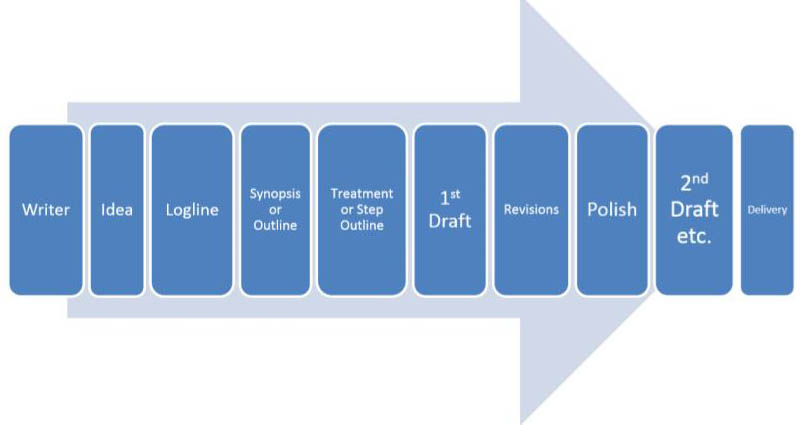
Figuring out the main story elements and putting them into a single sentence helps focus the writer at the start of a project. These main ideas that will make up the story are usually expressed in a logline. The logline will help determine focus and direction. Then an outline will help the writer figure out the turns of the narrative — the surprises, the ahas, the twists, the reversals. After the main beats are worked out in the step outline, the documentary writer will write a treatment to lay out the moment-to-moment story — everything that will be seen and heard in the ultimate film.
One thing to constantly remember when working on documentary is that the writer is not fictionalizing anything — not making things up. Instead the writer is using real-world footage such as interviews, b-roll shot (or bought) for the film, archival footage acquired through research, photographs, graphics, and the like.
B-ROLL – WHAT IT IS, WHAT IT DOES
Because documentaries are written around parts of interviews with the main characters of the movie, supplemental footage is needed so that it’s not just a bunch of talking heads on screen. B-roll helps visualize what the interviewees are talking about.
As the writer conceives of a documentary project, it is important to plan for ways to cut away from the main footage to bring the story to life visually.
DOCUMENTARY FILM ELEMENTS
All films consist of sounds and images creatively put together. Documentary films aim to tell a true story using visuals and sounds that are gathered to help tell the story. Below are the main types of visuals and sounds documentary filmmakers use.
VISUALS
- Action footage
- In interviews – subject(s) answering formal, structured questions
- People or other creatures doing things, at work, at play, carrying on everyday activities,
- Shots of landscapes and inanimate things
- People talking to each other, consciously contributing to the camera’s portrait of themselves
- Re-enactments, factually accurate, of situations from the past or which cannot be filmed for valid reasons or
- Written and staged scenes that are suppositional or hypothetical and are indicated as such
- Library footage – archival material or material recycled from other films
- Still photos
- Often these will be shot by a camera that moves toward or away from or across to enliven them
- Graphics
- Documents, titles, headlines,
- Line art, cartoons,
- Graphs of statistics, trends, etc.
- On-screen text
- Identifying speakers on camera
- Contextualizing what the viewer sees or is about to see
- Translations of someone speaking a language different than that which the film is using as its main language
- Blank screen
- Usually black or sometimes a white screen; having nothing on the screen often is used to focus on the sound; can also be used to cause reflection of what has been viewed, can also be used as a segue to the following scene or “chapter”
SOUNDS
- Voice-over
- Audio-only interview – constructed from the track of a picture-and-sound interview with occasional segments of sync picture at salient points
- Narration – scripted by the script writer and spoken by a narrator
- The voice of the director (Michael Moore in Bowling for Columbine, 2002; Raoul Peck in Exterminate All the Brutes, 2020)
- The voice of someone featured in the film – Note: this is the only type of narration that is allowed in the Doc Project
- Synchronous sound, that is, diegetic accompanying sound shot while filming
- Sound effects—can be spot (sync) sound effects or atmospheres
- Music
- Silence
ESSENTIAL STORY ELEMENTS
- Main character aka protagonist (hero)
- Setting – both time and place, world of film
- Inciting incident
- Goal of main character
- Conflict (main/core conflict)
- Antagonist
- Confrontation / Complication
- Rising action
- Climax/ Crisis
- Denouement/wrap-up
ANOTHER IMPORTANT CONSIDERATION: THEME
Theme is the central dramatic argument of a story. What point is the story trying to make? What is the screenwriter trying to say through the movie?
Examples of theme:
- You can’t judge a book by its cover.
- Men and women can’t just be friends.
- Life is beautiful even in the midst of horrors.
- Better to be dead than a slave.
- If you love someone, set them free.
STORY BASICS REVISITED
- The story about somebody (protagonist/hero) for whom we have some empathy – we need to care about him/her.
- The hero wants something and is taking a course of action to get that something.
- But, though this something is possible to do, achieve, get, getting what s/he wants proves difficult.
- The story is told for maximum emotional impact and audience participation.
- The story must have a satisfactory (not necessarily happy) ending. In other words, the conflict is resolved. Whether or not the character gets what she or he wants, s/he has grown / changed through the story’s journey.
REVISITING THE THREE-ACT STRUCTURE

Act I: The Setup
The main character / protagonist is introduced, along with the story world (setting). The character wants something. Something happens — an explosion of sorts in the everyday life of the main character occurs — and this throws the character’s world into turmoil. (That is the inciting incident.) The main conflict is set up. All of this must be done through SOUNDS and IMAGES, not explanations in the writer’s words.
Act II: Complication (Confrontation)
The protagonist is trying to reach a goal, trying to get that thing s/he wants, but has more and more difficulty trying to achieve his/her it. (The stakes rise.) But this trouble leads to the character’s growth.
Subplots are introduced and explored.
Act III: Resolution
The conflict is resolved; the protagonist grows through the pursuit that has provided much of the action of the story. Whether or not the main character achieves his/her goal, s/he has changed and b/c of the journey taken in the story.
Other story lines are tied up as well.
While documentary films are works of nonfiction, documentarians use narrative structure to pique the viewer’s interest and create suspense and tension similar to how a fictional screenwriter approaches story.
DOCUMENTARY FILM OVERVIEW: DEFINITIONS, TYPES & INGREDIENTS
DOCUMENTARY FILM: A non-fiction movie intended to “document reality, primarily for the purposes of instruction, education or maintaining a historical record.”
-
- Documentary films tell stories based on real events, people
- Nonfiction films can be:
- A film composed of footage of actual events, with or without narration
- A creative treatment of actual events
- A film with an absence of fictionalizing elements
- “Film which through certain conventions creates the illusion that the events depicted were not controlled by the filmmakers.”
- Director Peter Bogdanovich puts it like this: fiction films are written first and shot later, while documentary films are shot first and written later.
- Nonfiction films can be:
- Types of documentary films
- Expository documentaries aim to inform and/or persuade — often through omnipresent narration devoid of ambiguous or poetic rhetoric. Think Ken Burns and television (A&E, History Channel, etc.) styles. Specific examples: March of the Penguins, (Luc Jacquet, 2005), The Plow That Broke the Plains (Pare Lorentz, 1936)]
- Observational documentaries aim to observe the world around them. Originating in the 1960s alongside advances in portable film equipment, the cinéma vérité-style is much less pointed than the expository approach. Examples include: Hoop Dreams (Steve James, 1994), High School (Frederick Wiseman, 1968), Primary (Roger Drew, Richard Leacock, 1960), Salesmen (Albert and David Maysles, 1969), Grey Gardens (Albert and David Maysles, 1975), Don’t Look Back (D.A. Pennebaker, 1967)
- Poetic documentaries, first seen in the 1920s, focus on experiences, images, and showing the audience the world through different eyes. Abstract and loose with narrative, the poetic sub-genre can be very unconventional and experimental in form and content. The ultimate goal is to create a feeling rather than a truth. (Examples include the short doc “In Decision”)
- Participatory documentaries include the filmmaker in the narrative. This inclusion can be as minimal as a filmmaker using his or her voice to question or prod interview subjects or as major as a filmmaker directly influencing the actions of the narrative.Documentary filmmaker Michael Moore (Bowling for Columbine, Sicko, Roger and Me) often directly influences how his subjects react to his questions — sometimes relentlessly hounding and antagonizing them — and, therefore, he influences the overall narrative of the film in a way that can be labeled as participatory. But Michael Moore is a particularly complicated filmmaker. In addition to the Moore examples listed above, Sherman’s March (Ross McElwee, 1986) is participatory.
- Performative documentaries are an experimental combination of styles used to stress subject experience and share an emotional response with the world. They often connect and juxtapose personal accounts with larger political or historical issues.This has sometimes been called the “Michael Moore-style,” as he often uses his own personal stories as a way to construct social truths (without having to argue the validity of their experiences). Examples include Fahrenheit 9/11 (Michael Moore 2004), Supersize Me (Morgan Spurlock, 2004).
- Reflexive documentaries are similar to participatory docs in that they often include the filmmaker within the film. However, unlike participatory, most reflexive documentary filmmakers make no attempt to explore an outside subject. Rather, they focus solely on themselves and the act of making the film. Examples include Dziga Vertov’s Man With a Movie Camera (1929) and Louis Theroux’s Weird Weekends (1998).
- Documentary films tell stories based on real events, people
Week 2 Videos to Watch
“Nzingha”
6:00 | Directed by Anderson Wright, 2016
Read: Related article “Nzingha Prescod, Olympic Fencer”
“Snowy”
12:27 | Directed by , 2021
Watch to the video below to start to learn what a logline is, what they are used for, and how and why screenwriters use them when starting to write a script.
WRITING ASSIGNMENT: DP2 (3 parts)
BEGIN & COMPLETE: Assignment DP2 which has three parts. Note that you need a passing grade and a green light on your article from Assignment DP1 before doing this one.
Make sure you have completed the readings above before you start the assignment. Also, for all assignments related to the Doc Project, include both a PDF of and a link to the article you are working with.
This assignment has three parts which should be completed in the order they appear below.
PART 1 – GO THROUGH YOUR ARTICLE AND FIND THE AUDIO AND VISUAL ELEMENTS FROM IT
DOWNLOAD or MAKE A COPY of the document Doc Project Assets (note: you must make a copy of it — you cannot edit it directly, you must download it/make a copy of it) to re-imagine and “translate” the words in your article into video footage, other imagery and audio clips and categorize all paragraphs of the article into a specific type of footage from the list below.
For this spreadsheet, make it shareable with me [proferowell@gmail.com] so that I can read it. For everything else, make it a PDF.
PART 2 – WRITE A LOGLINE FOR THE DOCUMENTARY
After watching the video above on loglines, write a logline for the scipt you’re developing. Be sure to include the following: the protagonist (description, not name), the protagonist’s goal, the obstacles to that goal, the setting, the stakes.
PART 3 – IDENTIFY 13 BEATS IN THE DOCUMENTARY SHORT YOU’LL BE WRITING
Using the list below, identify 13 important details and moments in the story that you will develop into your documentary script. To find these moments, look at the quotes/audio clips listed in the Doc Project Assets in Part 1 above. You should find the AUDIO first, then describe a visual that can work with that quote.
1. How do you introduce your main character and the story world?
Example:
Audio: Lucas quote- As a felon, I have little choice for work.
Visual: B-roll of Lucas Alton, a 54-year-old American, working in his landscaping company.
2. Who’s our character and what do they want?
3. Who populates their world?
4. What immediately stands in their way of getting what they want?
5. What do they do to overcome this obstacle?
6. What else makes things hard for our main character?
7. How does our main character surmount the next big difficulty?
8. What changes in our character’s mood or outlook?
9. What is the next, more difficult obstacle our main character encounters?
10. What’s the worst thing that happens?
11. How does our main character react to the worst thing?
12. Does our main character fail or end up on top?
13. Where do we leave our characters?
When all PDFs are ready to be submitted, upload them to Brightspace using the link below.
Note: You must have successfully completed DP1 and gotten a green light for your article to attempt this assignment.
Section 0902 upload here » | Section 1000 upload here »
