

WEEK 1 WORK (Due Before Class 2)
MES153 0902 (Tuesdays): 1/27-2/2 | MES153 1000 (Thursdays): 1/29-2/4
A note about how OpenLab units work: Each week, a new unit will be posted with readings, viewings, and a written assignment that students must work through before the next class. The written work for each unit is due by noon the day before the following class; all other work for each unit should be completed before the next week’s class begins. The written assignments appear at the bottom of each unit. Participation in the following class will include work with these materials.
 READING ASSIGNMENTS
- What Is Story? (A Quick Take.)
- Mark Twain’s 18 Rules of Writing
- An Introduction to Three-Act Structure
- An Introduction to Documentary Film
What Is Story? (A Quick Take.)
“A Tale Shall Accomplish Something and Arrive Somewhere”
A story is not merely a series of events. A story must focus on a character (sometimes a group of characters) setting out to attain or accomplish something. Mark Twain’s first rule of writing was: A tale shall accomplish something and arrive somewhere.”
A story has structure. At its most basic level, that structure is beginning, middle and end. As students advance through this course, they should begin to understand that certain things must be included in those three parts (often called acts in screenwriting) and that there are essential elements of stories as well. Those elements include the following:
- protagonist
- want or goal
- deliberate action made to attain or achieve the want/goal
- antagonist
- conflict
- resolution
Other elements needed in a story for it to have the necessary structure include:
- inciting incident
- setting
- climax
- resolution
- falling action
Storytelling is tricky business. While we humans are wired to love stories and tell them, when it comes to storytelling, it’s not as simple as relating an anecdote. And the reason for that is that anecdotes don’t necessarily have the structure. So structure is something we will look at all semester, and the more you read and write and study structure, the clearer it should become in terms of what it is, why it’s necessary, and how you can build your own scripts with a solid structure.
Before going further with structure, though, it’s not a bad idea to begin a script-writing course with some writing tips by one of America’s premiere writers. So let’s take a look.
Mark Twain’s 18 Rules of Writing
- A tale shall accomplish something and arrive somewhere.
- The episodes in a tale shall be necessary parts of the tale, and shall help to develop it.
- The personages in a tale shall be alive, except in the case of corpses, and that always the reader shall be able to tell the corpses from the others.
- The personages in a tale, both dead and alive, shall exhibit a sufficient excuse for being there.
- When the personages of a tale deal in conversation, the talk shall sound like human talk, and be talk such as human beings would be likely to talk in the given circumstances, and have a discoverable meaning, also a discoverable purpose, and a show of relevancy, and remain in the neighborhood of the subject at hand, and be interesting to the reader, and help out the tale, and stop when the people cannot think of anything more to say.
- When the author describes the character of a personage in the tale, the conduct and conversation of that personage shall justify said description.
- When a personage talks like an illustrated, gilt-edged, tree-calf, hand-tooled, seven- dollar Friendship’s Offering in the beginning of a paragraph, he shall not talk like a negro minstrel in the end of it.
- Crass stupidities shall not be played upon the reader as “the craft of the woodsman, the delicate art of the forest,” by either the author or the people in the tale.
- The personages of a tale shall confine themselves to possibilities and let miracles alone; or, if they venture a miracle, the author must so plausibly set it forth as to make it look possible and reasonable.
- The author shall make the reader feel a deep interest in the personages of his tale and in their fate; and that he shall make the reader love the good people in the tale and hate the bad ones.
- The characters in a tale shall be so clearly defined that the reader can tell beforehand what each will do in a given emergency.
- Say what he is proposing to say, not merely come near it.
- Use the right word, not its second cousin.
- Eschew surplusage.
- Not omit necessary details.
- Avoid slovenliness of form.
- Use good grammar.
- Employ a simple and straightforward style.
Read more on the definition of story at Jane Friedman’s blog
THREE-ACT STRUCTURE: A QUICK INTRO
I. Setup – Intro setting, protagonist, want, conflict (main problem), antagonist
II. Complication – Conflict becomes increasingly difficult (rising action)
III. Resolution – Main conflict resolved, story threads tied up
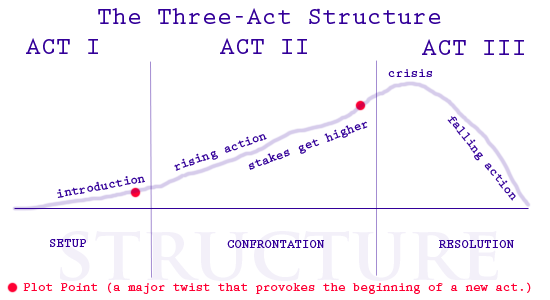
Note the Rising Action
To keep viewers’ attention, the screenwriter must make the obstacles more and more challenging for the protagonist. Our main character wants something and it’s clear to the viewer what that is, but boy does she have trouble getting it. Remember Craig Mazin’s way of thinking about it — the writer puts her or his main character through a torture chamber. And those tools of torture should turn the screw ever tighter on our protagonist, pushing her to the point of no return and the darkest “all is lost” moment.
The crisis point which marks the highest point of the drama will be where it is revealed if the character gets what she wants or not.
And then it’s just wrapping up any other story threads that require closure.
WRITING NONFICTION FILM/DOCUMENTARY (Part 1)
Excerpt from Sam Sloves’ Scriptwriting (2021)
Most people have an intuitive understanding of the difference between fiction and nonfiction film. Usually, we call anything based on footage of “reality” a “documentary film.”
And yet when we drill down into exactly what that means, things get a little tricky. Perhaps a more cumbersome if nuanced definition will help. A non-fiction film can be:
- A film composed of footage of actual events, with or without narration
- A creative treatment of actual events
- A film with an absence of fictionalizing elements
- “Film which through certain conventions creates the illusion that the events depicted were not controlled by the filmmakers.”
Most often, what we think of as “a documentary” is a film that uses actual events to form into a narrative. Under certain conditions, it may use recreations. So how does that make it different from a fictional narrative?
This commonly leads to the confusion between a documentary and a docudrama.
- A documentary is as described above.
- A docudrama takes actual events and creates a fictional script based on those events, and hires actors to play the people in the film.
Here are two clips from films that address the famous march on Selma.
One is the 2014 docudrama Selma scripted by David Webb that stars many famous actors including Oprah Winfrey, David Oyelowo, and Common and is directed by Ava DuVernay:
The other is a 2015 compilation called Selma: The Real Selma Footage that was edited together by Richard Morris from available sources:
The difference in presentation is stark—one “is” (at least for our purposes) composed of “reality”—on camera footage of events that happened in the world; the other recreates it.
The recreation is, appropriately, categorized as fiction because, unlike an eye-witness account or other document that conveys an undisputable authenticity, the actors and the actions are conceived for the camera.
Some completely staged docudramas, like Gilo Pontecorvo’s The Battle of Algiers or Paul Greengrass’s Bloody Sunday and Flight 93, correspond closely enough to the documented events that they “feel” like documentaries. Some documentaries, like José Padilha and Felipe Lacerda’s Bus 174 or Barbara Kopple’s Harlan County USA, are thrilling enough to be fiction.
The director Peter Bogdanovich, who has done both fiction and nonfiction films, has said that fiction films are written first and shot later, while documentary films are shot first and written later.
TYPES OF NONFICTION FOOTAGE
So a nonfiction film/documentary is very much an assemblage of one or more kinds of footage. Here are some of the various kinds of footage commonly used in documentaries:
Film/Video
- Actions: Footage of real-time events caught intentionally or unintentionally by on site cameras
- Talking heads/Interviews: These include those done “live” during an event and after- the-fact accounts, as well as all other forms of Q & As
- Archival/Historical/Library: This includes news footage, newsreels, “accidental news footage,” such as the Zapruder film of the JFK assassination or, more recently, Darnella Frazier’s Pulitzer Prize-winning footage of the George Floyd murder, and still photos or even drawings/rendering of actual events
- Stock: Moving image illustrations of people, places, and things in action, such as “Kids playing softball” or “1990s New York City Skyline” or “Microscope POV of Amoeba”)
- Graphics/Animation: Still photos, charts, graphs, explanatory or evidentiary drawings/renderings, key words, stylized titles, etc., as well as animations demonstrating/illuminating/positing actions or events
- Reenactment: This includes everything from hyper-realistic presentations that are meant to be seen as “real” to hyper-unrealistic versions that function as commentaries
Sound
- Sync footage of people talking
- Non-sync on-camera voices (from interviews, on-site video and/or audio event footage)
- Voice-over and Narration (note: scripted narration is not allowed on the Doc Project)
- Sound effects (SFX)
- Music
A Look at Different Kinds of Footage
Errol Morris’s The Thin Blue Line (1988)
Notice (in order of appearance):
VIDEO: reenactment(s), archive documents, archive photos, titles, on-camera interviews, stock photos, graphics, photos (taken for project), stock footage
AUDIO: music, sound effects, sync interview audio, non-sync interview audio (notice the voice over narration)
“Crip Camp” (2020) directed by James Lebrecht and Nicole Newnham
Notice (in order of appearance):
VIDEO: Archival video, interviews, archival stills, lower third graphics, and subtitles for what is said & who is speaking
AUDIO: voice-overs, music
All are multiple prize-winning films, but notice how in The Thin Blue Line, Erroll Morris uses no narration at all, while in the Sherman’s March clip, Ross McElwee begins with a traditional narrator, then pulls the rug out and uses a very different voiceover style. Crip Camp combines period music from the Woodstock era with voiceovers from the direct-to-camera interviews recorded 50 years later. The filmmakers discovered the footage shot during this remarkable summer camp and this allows us as viewers to be transported back in time to experience the freedom of this camp along with its young participants.
It is your choice; there isn’t any one way that’s “correct.”
“ARTIST AGNES MARTIN – BEAUTY IS IN YOUR MIND” | Written and directed by Lindsey Dreydon, 2016 | (7:37)
VIDEO: interviews, b-roll of Martin sitting and painting in her studio, b-roll of Martin’s art, subtitles/lower thirds identifying who is speaking
AUDIO: sync interview audio, non-sync interview audio, music
Questions to answer:
- What is the story of the rose in this doc short? Why is it important to this profile?
- What is the focus of this documentary short?
- What is the focus of the main character?
- What types of documentary footage are used in this doc short?
Starting the Process of Script Writing: Writing the Concept
A story is a particular series of cause-and-effect events in the main character’s life which lead to a change in that character. In order to start a story, the writer must have a concept to build from. From the germ of an idea, the writer tries to find the essence of the idea and then encapsulates it in a single sentence.
Why just one sentence? Because it is the essence of your story and should thus be able to be described succinctly.
In your concept sentence, you should identify the following:
- The protagonist (main character)
- The protagonist’s goal/objective/want and
- The main obstacle that the protagonist encounters while trying to achieve or attain her or his goal
- If your story is not based on a single character but on a subject, then find the debate and set up the two sides of the debate and the prox and cons of each.
Note that when describing the protagonist in the concept sentence, writers must consider how to do so not just with her or his name but also something essential to the character’s nature. (Remember it’s just one sentence, so you have a short phrase to provide info about your main character.)
Two Sample Concept Sentences
Because the audience for a concept sentence is the writer himself or herself, there are not tons of examples of concept sentences. But here are two concepts from two fictional films:
A boy and the very unusual balloon that he finds defy scorn, punishment, even violence to keep the friendship alive. (“The Red Balloon”)
Understanding the story elements expressed in the concept sentence for The Red Balloon: The protagonist in “The Red Balloon” is “a boy” (it is a silent film and so the audience never learns his name). The boy’s main objective is to keep his friendship with the balloon alive through all the conflicts he encounters, including “scorn,” “punishment” by the school master and “violence” threatened by other children.
A down-at-the-heels motorcyclist searches the streets and tunnels of London to turn a chance street encounter with a beautiful woman into the hookup of his dreams. (“Tunnel of Love”)
VIEWING ASSIGNMENTS
Before Week 2’s class, watch the videos listed below and be prepared to answer the questions in class. Note: The questions are not part of the written work, which is listed at the bottom of this page under the heading WRITING ASSIGNMENTS.
- Andrew Stanton’s TEDTalk
- Either “Copy Cat” or “Fish Story”
ANDREW STANTON: THE CLUES TO A GREAT STORY
Toy Story co-writer on Storytelling (19:16)
Questions to be able to answer in Class 2 next week:
- How is storytelling like joke-telling?
- What is the thing that Stanton says is probably the most important story commandment?
- What does Stanton mean when he refers to using “two plus two” instead of “four”? What point was he trying to make?
- Stanton talks about learning about a character’s spine through an acting teacher. What is that spine referred to in this context?
- Why did the Toy Story writers feel they had to make Woody selfish at the start?
- Does anyone remember the theme of Lawrence of Arabia or what the understanding of its role in the story did for Stanton?
- What did Stanton discover as a child that helped him understand later in life what an important element of storytelling is? Or what is that important element? Looking back, what movie is it that he remembered feeling this in?
“COPYCAT” | Written and directed by Charlie Shackleton, 2015 | (8:49)
Questions to be able to answer in Class 2:
- Who is the main character?
- What does he want?
- Name a source of conflict in the short film.
- The main character makes a movie – what’s the premise?
- How does the movie do?
- What is the climactic reveal in this doc short? (The biggest source of conflict)
- What is the ironic twist the short ends on?
“FISH STORY” | Written by Charlie Lyne and Caspar Salman, 2015 | (13:38)
Questions to be able to answer in Class 2:
- Who is the main character?
- What does he want?
- Who are the other characters in the story?
- Why is the short called “A Fish Story”?
- What is the main conflict in the documentary?
- Identify as many visuals you can and describe what kind they are.
- What can you say about the doc’s style? What about its tone?
- What kind of audio is used?
Writing Assignment – Documentary Project 1 (DP1)
Brightspace Upload Links: Section 0902 || Section 1000 – Upload here
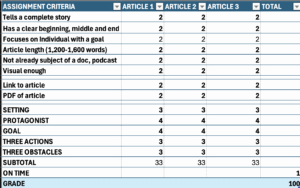
TASK: Find three LONG news articles that could potentially be the basis for a shorter, 10-minute documentary script. Note that the subject must not already be covered in an existing film or podcast (so avoid pieces on Vice.com or any of the stories in ESPN’s “30 for 30” series, etc.).All three ideas should be stories that really pique your interest and would engage others too. Read additional details below.
- Find three potential stories – Find articles from good sources such as Vanity Fair, Rolling Stone, The New Yorker, Harpers, The Atlantic, The New York Times Magazine, Wired, etc. Do searches on those sites or through your search engine of choice on topics that interest you a good deal and have enough visual aspects that make the story suitable for a documentary film. All three potential story ideas should:
- Have between 1,300 and 1,600 words in length
- Tell a complete story. No ongoing dramas; the narrative must have a clear resolution
- Have a beginning, a middle and an end
- Focus on a single individual (see these short films on the site “Nzingha,” “Little Potato,” “Who Says I Can’t,” “The Roper“) or a single idea (“In Decision,” “Copycat,” “Valley of the Doll“)
- Contain enough visual elements in it for a documentary film.
- For each of the three news pieces:
- Write a list that identifies the following five story elements:
- the setting
- a protagonist
- the protagonist’s goal
- three actions the protagonist takes to achieve the goal
- two to three obstacles that stand in the way of the protagonist achieving his/her goal
- Include BOTH a link to and PDF of all three articles.
- Upload to Brightspace
- One PDF of the assignment with three list of each potential idea/basis along with a link to each article
- Three additional PDFs containing the full text of the articles.
- Write a list that identifies the following five story elements:
UPLOAD WORK HERE
Upload PDFs to BRIGHTSPACE » MES153 0902 here| || MES153 1000 here
BIG PICTURE: Students must find a good, long feature news article that they will reimagine as sounds and images to write a documentary script for.
For the first half of the class, students must find three long news features on a subject they like from which a three-act narrative can be built (the stories must not have already been turned into a film or podcast). One of those articles will then form the basis of their nonfiction project; students will reimagine the article as video elements from which they can craft a hypothetical documentary script (so, for example, people quoted in the article would effectively be on-camera interviews, important places could be translated into b-roll, important statistics could be rendered as graphics, etc.).
