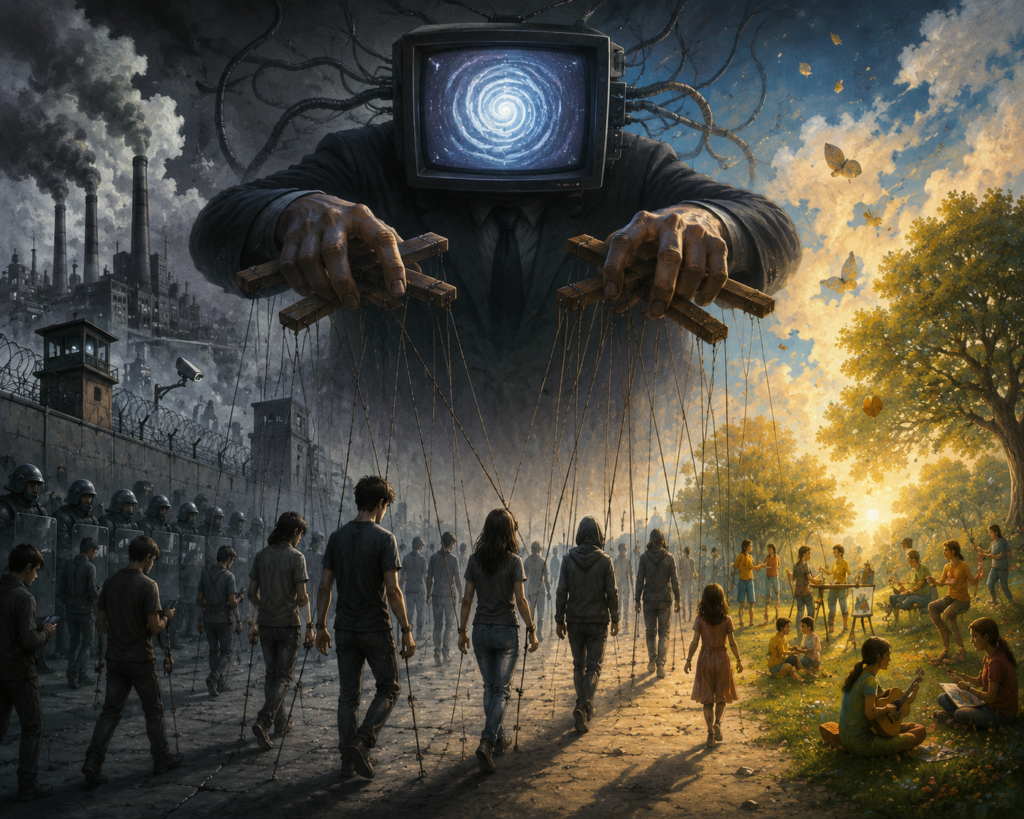
It is a political concept proposed by Louis Althusser, referring to the institutions of the state that operate by violence and coercion (such as the army, police, courts, and prisons). Their main function is to use coercion as a means to maintain the order of the ruling class, suppress opposition forces, and ensure the control of the people in power over society. Althusser calls it repressive because it limits the freedom of the people by pushing for obedience not allowing for any real choice.
It refers to institutions that operate through social institutions such as education, family, religion, and media whose main function is to reproduce capitalist relations by shaping beliefs, values, and consciousness to maintain order of the ruling class, suppress opposition forces, and ensure the control of the ruling class over society. They work by creating systems and conditions where people are taught obedience and conformity which are then reinforced at institutions like schools and churches.
The main difference between the repressive state apparatus proposed by Althusser and the ideological state apparatus lies in their operational mechanisms. RSA maintains it is ruled through “violence” and “ coercion” such as military and police, courts while ISA thought through “ propaganda” and persuasion such as school, churches and media. Both are for the reproduction of the ruling relationship, but the former is overtly coercive, while the latter internalizes ideology, jointly ensuring the ruling order.
Image of example of Vegetarianism – Ideological apparatus
1- Louis Althusser describes the Repressive State Apparatus as a collection of social structures that keep stability using power, penalties, or anxiety. Experts claim that the police, military, judicial systems, and incarceration facilities are the primary organizations within the Repressive State Apparatus. Order is preserved by the Repressive State Apparatus through the application of physical strength or the threat of legal action. Because individuals feel worried about the results of violating regulations, the Repressive State Apparatus is called “repressive” by Althusser. Governments utilize the Repressive State Apparatus so that authority is held over the general public. When a person performs an illegal act, the police force detains that individual while the judicial system mandates a period of confinement. It has been observed that the Repressive State Apparatus creates a situation where the law is respected because humans are terrified of being penalized. This specific character of the Repressive State Apparatus is defined as repressive because control is achieved through intimidation. Citizens follow the rules when the Repressive State Apparatus demonstrates the strength of the government.
2-Societal structures known as Ideological State Apparatuses function as organizations that guide the thoughts, morals, and actions of the community rather than using physical power. Educational institutions, religious groups, kinship circles, communication networks, and local traditions serve as prime examples of these systems. Experts claim that Ideological State Apparatuses provide instructions on what the community views as standard, proper, or prosperous. Because these organizations exist in every part of life, the collective consciousness of the public is directed toward specific social norms through constant exposure. The operation of Ideological State Apparatuses depends on changing how the human mind understands reality. Educational institutions provide lessons that go beyond mere reading and writing because they also demand order, submission, being on time, and honoring those in charge. Many people believe that the population starts to embrace these perspectives as natural truths without any doubt because the influence is constant. Punishment is avoided by Ideological State Apparatuses because these systems rely on the power of thoughts and convictions, unlike Repressive State Apparatuses.
3-Social order is maintained through different strategies by the government. Experts claim that the distinction between Repressive State Apparatuses and Ideological State Apparatuses exists because of the different tactics these systems employ to regulate the community. The method of governing populations is determined by the specific tools that the ruling power chooses to use. While Repressive State Apparatuses rely on physical strength, Ideological State Apparatuses utilize the mind. Because power needs stability, these two systems function together even though they work separately. Violence and the threat of harm serve as the foundation for Repressive State Apparatuses. It has been observed that Repressive State Apparatuses utilize force and punishment so that the population follows the legal requirements. Strict obedience is demanded by organizations such as the police and the military forces. These groups, judicial courts, and correctional facilities ensure that individuals do not break the law because fear is a powerful tool. When a person refuses to follow the rules, the Repressive State Apparatuses intervene to correct that behavior through physical means. Internal thoughts and personal perspectives are the focus of Ideological State Apparatuses. Many people believe that Ideological State Apparatuses are effective because they change how a person thinks. Beliefs are shaped by the educational institution and the communication networks that people consume. Other examples include religious organizations and the private household unit. Because Ideological State Apparatuses teach the values of the ruling system, individuals follow the rules of their own free will. While Repressive State Apparatuses use the body, Ideological State Apparatuses use social conditioning to manage the spirit.
4-The image shows how society and powerful institutions influence people’s thoughts and behavior without using force. The puppet strings symbolize invisible control through media, culture, and social systems, connecting to Althusser’s idea of ideology shaping people’s beliefs.
A Repressive State Apparatus is place that maintains order with force or by threatening it. He calls it repressive because they use repression to get people to act “correctly”. For example the police. If you do something bad , you will go to jail. A lot of people follow the law in fear of having to be stopped by the police.
Ideological State Apparatuses operates with ideas or beliefs. The point of it is to have people do things willingly instead of forcefully. For example church, we believe that God wants us to obey and so we choose to do it willingly. Our faith fuels our actions and our decisions to do what is right. We don’t have to, we want to. There’s willingness there.
The different between Repressive and Ideological State Apparatuses is their approach. Repressive centers on fear by forcing but Ideological gives a chose so people are more compelled to be willing.
A Repressive State Apparatus (RSA) refers to the institutions through which the state maintains order mainly through force or the threat of force. According to Althusser, these include things like the police, the military, the courts, and prisons. These institutions exist to make sure people follow laws and rules, even if they don’t personally agree with them. Althusser calls it “repressive” because these institutions rely on punishment, coercion, or physical force to control behavior. Even when force isn’t actively being used, the possibility of it is always there. For example, most people stop at red lights not because they deeply believe in traffic laws, but because they know there could be consequences like fines, tickets, or arrest. The system works because people know what will happen if they don’t comply.
An example of a Repressive State Apparatus is the police. If someone breaks the law, the police have the authority to arrest them and use force if necessary. This shows how the state enforces rules not by persuasion, but by power backed by punishment.
2.) Ideological State Apparatuses (ISAs) are institutions that shape the way people think, believe, and understand the world. Unlike RSAs, they don’t rely on force. Instead, they work through ideas, values, and norms. Examples include schools, families, religion, media, and culture. These institutions seem harmless or neutral on the surface, but they play a powerful role in shaping ideology. They teach people what is considered normal, right, or successful in society. For example, schools don’t just teach math or reading, they also teach discipline, respect for authority, competition, and punctuality. Over time, students internalize these values and carry them into adult life. ISAs work quietly and constantly. People usually don’t feel controlled by them, which actually makes them more effective. Because the ideas feel natural or like common sense, people accept them without questioning where they came from or who they benefit.
3.) The difference between Repressive State Apparatuses and Ideological State Apparatuses is how they control people. RSAs make people obey because they have to. ISAs make people obey because they believe it’s the right or normal thing to do. Both are important, but Althusser suggests that ideology is especially powerful because it works without people realizing it. Repressive State Apparatuses work through force or the threat of punishment, like the police, courts, or prisons. You obey because you’re afraid of the consequences. Ideological State Apparatuses work through ideas and beliefs instead. Things like schools, media, and family shape how you think, so you end up following the system because it feels normal or right, not because anyone is forcing you.
4.) An example of ideology is the American flag displayed in classrooms often alongside the Pledge of Allegiance. This is an example of an Ideological State Apparatus, specifically connected to education and nationalism. The flag and the pledge don’t force students to believe anything through punishment, but they quietly teach ideas about patriotism, loyalty, and respect for the nation. Over time, students may come to feel that loving the country, standing for the pledge, or respecting national symbols is simply normal or morally right. What makes this ideological rather than repressive is that no physical force is usually involved. Instead, the message works through repetition and social expectations. Students internalize these values early on, often without questioning where they come from or why they matter. This shows how ideology shapes beliefs and identity in subtle ways, especially through everyday routines that seem harmless or neutral.
Repressive state apparatus is the idea that people are controlled through fear in order to regulate their actions and behaviors. Althusser calls it repressive because it relies on force, punishment, or the threat of violence to make people comply with societal rules. Repressive state apparatus controls people directly rather than through beliefs. An example of repressive state apparatus is a police officer arresting someone who breaks the law, using force or threat of force to enforce the law.
Ideological state apparatus controls people through the way they think rather than through force. It works by shaping beliefs and thoughts so that people behave a certain way because they believe its what they are “supposed to do”. Instead of being forced, people follow the rule willingly in order to be seen as non problematic, acceptable or normal. A clear example of this is a student behaving in class because that is what a ” good student” is expected to do, without any threats or force. Schools are an important ideological state apparatus because they teach students not only academic subjects, but also discipline, obedience,and social expectation. Shaping behavior long before repressive state apparatus is needed.
Repressive state apparatus and ideological state apparatus differ in how they control people. Repressive state apparatus relies on force, punishment,and threats such as arrest or imprisonment, to force people to comply. Ideological state apparatus works by shaping beliefs so that people follow rules willingly and without realization that they are being controlled. While ideological encourages people to comply on their own, repressive state are used when people defy or resist.
An example of ideology can be viewed in the film The Notebook, there is a scene where Noah leaves and joins the army and Allie goes to medical school. Both characters follow these paths because they believe it is what they are supposed to do based on social expectations, class and individual responsibility. This represents ideological state apparatus because their behavior is guided by inner beliefs shaped by society rather than force or threat.
1.Althusser explains that the Repressive State Apparatus is referring to state institutions that maintain order and control through force. He calls it “Repressive” because these same institutions that use punishment, fear, and even physical consequences. This is in order to protect people in that are in power so they can maintain that system. Repressive actions can be involved with threat of harm or even physical harm. This also impacts how a person losses rights and can end up in prison. an example is that when someone breaks the law the police and courts punish them this is how states use repression to keep order and control.
2. Ideological State Apparatuses are different than repressive ones because they are not relying on force. Instead they influence how people think and understand what is going on in the world. according to Althusser ISA includes incorporating every day institutions such as culture, media, religion, political systems and even music it tends to shape values and beliefs. ISAs work by making certain ideas seem normal and natural so people can follow the system more willingly for example not only do you learn academics in school settings but you also manage to teach discipline and rules.
3. The difference between RSA and ISA is how they maintain power. while RSA uses force to control behavior and ISA gets people to abide by the laws through genuine belief. Although both work to maintain power they operate in very different ways.
4. Zootopia is my example because i feel as if the movie shows us social roles and stereotypes is normal and challenges them. It is ideology because it explains how society will teach people their “place” at an early age.
The repressive state apparatus is order and control. This helps people follow rules because they fear the consequences that can happen if they don’t. Althusser called it repressive because he felt people obey the law. After all, they did not want to receive any type of punishment. For example, many people will not steal from the store because the outcome will be jail, and it will be on their record forever.
The ideological state apparatuses are beliefs and how people think. This helps people to believe what is normal or acceptable. It shows how people understand their role in society and choose what path they want to take in life. Such as when we go to school, we are being taught discipline. We are taught to have respect for teachers and listen to the information they give us.
A repressive and Ideological state is different because one is about control and order, and one is about beliefs, values, and what norms are supposed to be accepted.
This example really stood out to me because you see a bunch of personalities and people living different lives. This is showing how society will punish you and control you with symbols and authority.
A Repressive State Apparatus refers to institutions that maintain order mainly through force or the threat of force. These include the police, courts, prisons, military, and government authorities. Althusser calls it repressive because these institutions work by enforcing rules and laws through punishment, violence, or coercion rather than persuasion.
Example: The police arresting and imprisoning someone for breaking the law is an example of a Repressive State Apparatus at work.
2. Ideological State Apparatuses (ISAs)
Ideological State Apparatuses are institutions that shape people’s beliefs and values rather than using force. These include schools, religion, media, family, and culture. They work by teaching people what is normal, acceptable, and expected in society so that individuals willingly follow social rules.
Example: Schools teach students discipline, obedience to authority, and competition, which prepares them to fit into the workforce and social system.
3. Difference between Repressive and Ideological State Apparatuses
The key difference is how they operate.Repressive State Apparatuses work mainly through force and punishment, while Ideological State Apparatuses work through ideas, beliefs, and social norms. RSAs control people physically, while ISAs influence how people think and behave so that they accept the system voluntarily.
Example:The Pursuit of Happyness (job interview scene)
Type:Ideological State Apparatus
Explanation: This scene promotes the idea that hard work and determination lead to success. It shapes how people think about success and poverty without using force, which makes it an example of an ideological
1.The RSA is how the government uses force to control people. The RSA includes the police, courts, jails and the military. Althusser calls this apparatus “repressive” because it works by creating fear in people. It creates fear by making people believe that if they do not follow the rules, there will be consequences for their actions. For example when an individual commits a crime they may be arrested and put into jail. When individuals obey the rules it is often because they are afraid of what may happen to them if they do not.
2.Ideological State Apparatuses teach people through beliefs rather than force. They include education (schools), family, religious institutions, mass media (including television and newspapers) and political systems. As a result, they shape your idea of what is “normal” and how you ought to act. To illustrate this consider school. School teaches you to follow rules, to obey authority, to arrive on time, and to work hard. Because no one uses force against you, you develop these behaviors over time. When you grow into adulthood, you will have developed an understanding of working life and authority that has been shaped by these behaviors.
3.The two state apparatuses differ on their methods to control society. The Repressive State Apparatus controls by use of force and punishment police, prisons. The Ideological State Apparatus controls through ideas and habits school, media that are incorporated into a person’s belief system. In simpler terms repression relies on the fear of consequences whereas an ideological state apparatus relies on a persons’ belief systems to function. Typically the majority of social control is provided by the ideological state apparatus, with the repressive state apparatus stepping in once the ideological state apparatus has failed.
A Repressive State Apparatus (RSA) is a set of institutions that the state uses to maintain control by using force or the threat of force. These institutions make sure that people follow the law, even if they don’t want to. Althusser calls it “repressive” because these institutions operate mainly through coercion rather than persuasion. If someone refuses to comply, the RSA can punish them physically, legally, or through imprisonment. An example of repressive state apparatus is the police; if a person is caught stealing, the police can arrest them, they are then sent to court and may be imprisoned for committing the crime. Compliance is enforced through the punishment of being arrested and or imprisoned.
Ideological State Apparatuses (ISAs) are institutions that maintain social order by shaping people’s beliefs, values, and ways of thinking, rather than using force. They work by making the existing social system feel natural giving people a sense of normalcy. Instead of forcing obedience, ISAs encourage people to willingly participate in society. ISAs operate mainly through ideology, meaning shared ideas about what is right, normal, or desirable. An example would be schools, aside from what it teaches you through books, it also teaches you punctuality, obedience, and the idea that success is what that person makes of it. Overtime, you internalize these ideas and act accordingly without being forced.
Key differences between RSA and ISA Methods: RSA works mainly through force and punishment. ISA works mainly through ideas, beliefs, and persuasion. Visibility: RSA is visible and obvious (police, prisons, courts). ISA is often invisible (media, culture, school concepts) Primary Tool: RSA uses violence or the threat of violence. ISA uses ideology. Compliance: RSA forces people to obey. ISA makes people want to obey.
RSAs control behavior directly, while ISAs shape how people think so control feels unnecessary.
The U.S democracy is described as “government of the people, by the people, for the people.” This suggests that the government represents everyone and that the citizens have a real voice in how the country is run. This is an ideological apparatus because it influences how people think about the government without using force. Through speeches, media, and civic rituals like voting, it encourages people to see that the political system is fair and representative, even when access to power may be unequal.