Dr. Jean-Yves Plaisir’s Profile

Courses

ECE 410 Special Education Course ECE 410
This course examines the education of children (birth to eight years) with special needs, along with the historical, social, cultural, and legal foundations of special education in the U.S. It explores the causes and effects of various exceptionalities, including emotional, intellectual, physical, visual, auditory, orthopedic, speech and/or language and giftedness. Techniques for differentiated learning and universal design approaches will be analyzed; issues of ethnocultural diversity and computational thinking in teacher education, including discussions on methods for working with the families of children with special needs. It is also a writing-intensive course that pays special attention to developing critical reading, writing, and analytic skills to prepare students for college-level coursework in general. Both informal and formal writing will be designed to maximize your understanding of the subject matter. Formal writing assignments, at least 10-12 pages total, account for a significant portion of your grade and will include opportunities for revision.

Educational Foundations and Pedagogy of the Exceptional Child
This course examines the education of children (birth to eight years) with special needs, along with the historical, social, cultural, and legal foundations of special education in the U.S. It explores the causes and effects of various exceptionalities, including emotional, intellectual, physical, visual, auditory, orthopedic, speech and language and giftedness. Techniques for differentiated learning and universal design approaches will be analyzed; issues of ethnocultural diversity and computational thinking in teacher education including methods for working with the families of children with special needs are integrated into the course. This course requires 30 Hours of Fieldwork, which may be completed through video analyses and commentaries. Please, note that school sites may not be available for fieldwork activities due to the coronavirus pandemic; we will make reasonable adjustments to fulfill fieldwork requirements in the course. This is a Writing Intensive course that fulfills the WI requirement for graduation. Writing intensive courses pay special attention to developing critical reading, writing, and analytic skills to prepare students for college-level coursework in general. Both informal and formal writing will be designed to maximize your understanding of the subject matter. Formal writing assignments, at least 10-12 pages total, account for a significant portion of your grade and will include opportunities for revision.
Music, Culture, and Child Development
This course focuses on providing teachers with tools and activities to support young children’s musical, cultural, and physical development.

ECE 411 Early Childhood Practicum II – Fall 2021
This course is designed to develop practical and evidence-based knowledge for teaching literacy and enable students to demonstrate competencies teaching young children. It requires supervised participation in an assigned early childhood education setting and attendance at a weekly seminar. Students will explore principles, methods, and materials for teaching emergent literacy within a developmentally appropriate, interdisciplinary and culturally responsive curriculum. Current research regarding speaking, listening, reading and writing experiences of young children will be critically examined. Practical classroom experiences will provide opportunities for students to make connections between theory and practice, develop professional behavior working with young children and their families, and build a comprehensive understanding of balanced literacy in early childhood classrooms. Students will design, implement and evaluate activity-based literacy learning experiences for young children with diverse learning styles and needs, with strong emphasis on child centered, play-oriented approaches to teaching, learning and assessment, and knowledge of curriculum content areas.
Communities

A collaborative space for BMCC faculty to connect around topics such as teaching and learning, scholarship, career development, and digital education.
Black Studies Across the Americas (BSAA)
This project is supported with U.S. Department of Education Title VI National Resource Center funding from the Center for Latin American Studies at The Ohio State University and the NYU Center for Latin American and Caribbean Studies as well as the the BMCC Dept. of Ethnic and Race Studies and the President’s Fund for Innovation and Excellence, funded by McKenzie Scott. BSAA faculty and student researchers create OERs to help integrate Black studies into disciplines that historically don’t address Blackness and questions of race and ethnicity. BSAA OERs are hosted here on the BMCC OpenLab to foster further collaboration and use of the OERs at BMCC and beyond.
Music, Culture, and Child Development
This course focuses on providing teachers with tools and activities to support young children’s musical, cultural, and physical development.
Projects

Why Men’s Participation Must Become a Structural Priority in U.S. ECEC Systems
This paper reframes male underrepresentation in ECEC not as a cultural inevitability but as a structural challenge requiring coordinated policy action.
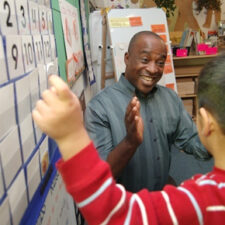
Mentoring Men in 3K through 2nd Grade Settings Across Cultures and Contexts
This international research collaborative aims to increase understanding, create strategies to mentor and support male educators, and expand existing efforts to foster gender-mixed teams in 3K through 2nd-grade settings across cultures and contexts. Self-identified male educators, working in 3K through 2nd grade, are invited to participate in the study by completing an online Survey.
The website offers support and updates on assessment topics at the faculty level

A space for faculty to share ideas about how to support student learning during the transition to distance learning for the remainder of Spring 2020. Please request to join if you are faculty at BMCC. Click on “Visit Project Site” in the upper right to access BMCC’s Course Continuity Resources website.
This is a sample profile and website for the ECE 210 Website or Podcast Advocacy Project.