Discussion

  1. What concept that we have already discussed does “faction” remind you of? 

Ideology

  1.  According to Federalist #10 (written by James Madison), what is the source of wealth (private property)? What factor explains why some people get to possess wealth by owning private property, and others don’t (thus remaining poor)? This is a key question, because it shows how the authors of the Constitution thought about the difference between different classes of Americans! HINT: focus on the passage that begins: “The diversity in the faculties (WHAT DOES FACULTIES mean or refer to?) of men, from which the rights of property originate, is not les….”

He believed that people acquired wealth through “talent” this i supported when he says  “So government is there to see that those who have a talent for getting rich are not hampered in any way by those who might be made poor in the process.” 

  1. Do you agree with this explanation of wealth and poverty?

No I do not agree that rich people get rich solely because of talent. Some people get rich off luck or other thing…

  1. What is the core mission (“first object”) of the US government? Does this surprise you, does it sound different from what our society today seems to suggest the core mission of the government is? Explain. 

 Their core mission was “The protection of these faculties is the first object of government. From the protection of different and unequal faculties of acquiring property.” And it does not surprise me that these selfish men made rules to protect themselves and it does not sound that much different than things today. For example rich people still try to find loop holes to be taxed less. 

  1. Given the discussion in questions 1-4, are you surprised that Federalist #10 is not in favor of democracy, and supports a Republican (representative) form of government? Why would d the author dislike a (pure) democratic form of government? Hint: think about how this question connects with the social classes…

No, i am not surprised these men gathered to make rules just to protect their own wealth and manipulate society into thinking they have right and that they matter 
Discussion 6.1

  1. Based on the arguments presented in Readings 6.1 and 6.2, which social class wrote the Constitution, and which class was excluded and not allowed to participate in this process? 

The Elite wrote the constitution, and the lower working class was excluded and not allowed to participate in this process. “In 1787, just such wealthy and powerful “gentlemen,” our “Founding Fathers,” congregated in Philadelphia for the professed purpose of revising

the Articles of Confederation and strengthening the central government.” “Small farmers were burdened by heavy rents, ruinous taxes, and low incomes. To survive, they frequently had to borrow money at high interest rates. To meet their debts, they mortgaged their future crops and went still deeper into debt. Interest rates on debts ranged from 25 to 40 percent, and taxes fell most heavily on those of modest means”

  1. Would say that the social class structure of early United States society was the same as ours today, or different? Explain.

It’s definitely different.Today, wealth is even more squeezed at the top, with the top 1% holding most of the riches compared to the 10%, we have no slaves, and everyone over 18 can vote. 

  1. Why were the people who wrote the Constitution so afraid of democracy? Hint: think about how to answer this question by discussing it in terms of social classes.

Because they did not want the majority of common people using their power to take their wealth 

Discussion 5.3

Which statistic on wealth inequality in the US (discussed on p. 29) made the biggest impression on you? Explain why?

The statistic that the top 1 percent own between 40 and 50 percent of the nation’s total wealth still shocks me because it is so unfairly distributed. There is no need for one person to have all that wealth.

What could be some of the implications of living in a society that has such huge wealth inequalities? Do you see this dynamic getting played out in everyday life in our society? How so? 

Some implications of living in a society that has such huge wealth inequalities is consumer debt, and unemployment. I do see these dynamics being played out in society. Almost everyone I know who has graduated from college is in a huge amount of debt that they cannot get out of, not only this but every day i see videos on social media speaking about not being able to enter entry level jobs after college or even service industry jobs. People are struggling to be employed and it is not because people are unqualified. 

Discussion Board 5.2

  1. As we learned thus far, the capitalist class consists of people who own wealth, as well as the means of production in American society. An important question in understanding how this class works is to ask: how does a capitalist remain wealthy? The answer to this question depends largely on understanding the diagram M-C-M’. So, let’s practice by explaining what happens in this diagram in our own words (but basing our ideas on Reading 5.1). Respond to the following question:  Explain M-C-M’ to show how capitalists maintain and increase their wealth. (hint: your answer should weave a summary that includes what you reviewed in the self-assessment exercise question 1-7)

When the aim is no longer to sell in order to buy but on the contrary, to buy in order to sell, or rather resell. The movement of exchange then becomes M (Money) – C (Commodity) – M’. Capitalists start with money, then use it to purchase commodities, including labor power, and then uses those commodities in production. Labor power then creates new value producing surplus value. The capitalist sells the finished product for more money than they originally invested in which is what M’ means. 

Discussion Board 5.1

  1. Two key concepts in this video are the means of production and labor. In your comment, explain how you understand the means of production and labor. Give an example of each. 

To my understanding the means of production means having the right equipment to produce the product you want to sell. For example to start a bakery you need core heavy-duty machinery, prep tools, and retail fixtures to even start. Labor is important because it’s the only thing that can increase the value of what you have.For example say you have a recipe for a cake that a lot of people like, you could sell that recipe to a big corporation or you can sell it at your bakery. If you sell the recipe you will probably earn a one time profit for the recipe, but if you keep selling the cake at your bakery then you will continuously profit off of that recipe. 

  1. Another important concept in understanding social class is value. Based on the ideas presented in Video 5.1, what is value?  What gives “value” to value, what makes something valuable? 

Value is the importance of something and how much its worth, labor makes something valuable.

  1. How are labor and value related? What’s the relationship/connection between the two?

The more labor it takes to make something under normal conditions the more valuable it is. There needs to be labor in order for something to be valuable 

  1. How do you understand the difference between labor and labor power? Hint: this is a key difference, give it your best shot based on what the video says about it, and your own ideas. We’ll clarify and develop it in our discussions, and in my video comments

Labor is the thing that makes something valuable and labor power is the importance of labor

  1. Surplus Value: what is it? Why is it important to know about, in our study of social classes? Think about an example of surplus value?

Surplus value is the extra value aka profit that big businesses keep to sell off to put money in their pocket.

Discussion 4.2

  1. What is the distinction that Reading 4.3 makes between owners and employees? Give an example of each.

Reading 4.3 makes it clear that “the owning class live mostly off investments, which include stocks, bonds, rents, mineral royalties, and other property income” while employees make their money through “mostly off wages, salaries, and fees”

Ex:Elon Musk

Ex:Tesla factory workers 

  1. How do you understand the quote by Adam Smith on pg. 28? What is it saying about labor?

 I think the quote is trying to say that a product only becomes valuable because of the labor that goes behind it. It is saying labor is the most important part.

  1. What are your thoughts on the main argument of Reading 4.4 that class is NOT an identity? 

I  agree that class is not an identity, i think like the reading discusses a registered nurse and a tomato picker can both be in the same class but have two different lifestyles and backgrounds 

  1. How do you understand the argument Reading 4.4. makes when stating that “class structures are built around a close form of dependency”? What is this close form of dependency, and can you think of an example?

This means that both workers and owners depend on each other for profit.

A factory employee depends on the factory to earn income and the employer depends on the factory workers to produce products. Without the factory employee the employer would have nothing to distribute to customers. 

Hailie Ayala-3.2

  1. What is a Repressive State Apparatus? Why does Althusser call it “repressive”? Can we explain his choice of words here. Give an example. 

 An oppressive state apparatus is a direct form of discipline that punishes people for falling out of line such as the police, the military, and any other disciplinary institution. Repressive is defined as  “controlling people by force.” (The Britannica dictionary) which coincides with Althusser’s definition of repressive state apparatus.

2. Let’s do the same for the Ideological State Apparatuses. What are they, how do they seem to work? 

Ideological state apparatus is a much more indirect method of keeping people in check. ideological state apparatus uses education, culture, and religion to make you believe and accept society’s rules.

3. Important: this question will appear on our exam: How are the Repressive and Ideological State Apparatuses different from each other? What is the difference between the two?

Ideological state apparatus and Repressive state apparatus are two very different forms of keeping people in line with society. Repressive uses a more forceful approach, while ideological uses a more persuasive and mental manipulative approach. ideological state apparatus is more obligatory because of the concept and ideas that are taught in school are forced upon us and if we don’t comply we learn from a young age that there will be consequences to not conforming 

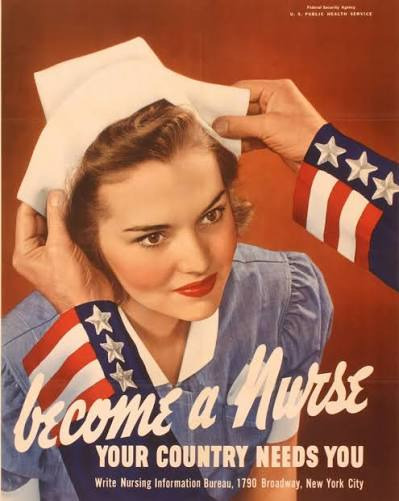
4. Post an example of ideology. This could be a piece of writing, an image, video, pdf document, visual art, or music, clip from a movie. Next to your example, specify if this is an example of repressive or ideological apparatuses at work. I’ll start us of off by giving an example

This poster was from back when Women were not allowed to fight in the military

Hailie Ayala- Discussion 3.1

1. Keeping in mind the material covered in this lesson, describe how you understand ideology in YOUR OWN WORDS.

Hint: One way to approach this is as follows

a) Describe what ideology is in a brief paragraph (in your own words). 

b) Give an example illustrating what you wrote in (a).

c) Write another paragraph (or two), explaining to your reader with additional details, how you understand ideology.

Ideology is a kind of umbrella term to categorize the ideas, beliefs, values or characteristics that a person or group identifies with. It can influence your political, religious and societal beliefs. For example, as Americans we have a government that operates under a two party system, Democratic and Republican. Democrats lean towards the “left” which coincide with liberal ideologies and Republicans lean towards the ”right” which coincide with conservative ideologies.

My understanding of ideology is that it is something that can categorize people’s ideas, beliefs, and way of living into simple terms. You can identify yourself as a republican, even if not all your ideas and beliefs align with the umbrella term Republican or Conservative. Ideologies have labels that make them simple and easy to follow.  

An example of ideology is left wing populism. Left wing populism focuses on conflicts between “big guys” and “little guys”. AKA the wealthy and regular people. 

2. How do you understand the difference between conservative and liberal ideology in US politics? What seem to be the big differences, the dividing line? Given an example to backup your arguments.

Hint: try to identify key words (concepts) that play a big role in making someone consider themselves to be liberal or conservative. Then, explain in your own words what those keywords (concepts) mean.

American conservatives believe in the free market and that it will provide the greatest economic opportunity and benefit to the greatest number of people. They also believe in a strong defense and that lower government spending will lead to lower taxes. And most of all they value liberty.

American liberals believe that the government can help solve problems and a bigger government can help solve more and bigger problems. Liberals are all for government intervention in forms such as regulations and higher taxes, especially when government intervention helps historically marginalized groups like minorities, women and the poor. Liberal don’t believe the free market will be fair to everyone so they like to see the government step in on the behalf of consumers to protect the environment. They favor higher taxes or the rich and corporations. They also believe we spend more than enough money on the military. And most importantly to liberals they value equality. 

3. How do you understand Althusser’s definition of ideology? Paraphrase it in your own words. Given an example. Hint: you may have to watch the second video again, and find the few places where Althusser’s position is presented.

Hint: Remember, the discussion boards are crucial for us this semester, because they reproduce our in-class conversations. Try to be thorough and write more, rather than less. I will do the same, and make sure by the time we end our discussion, we have covered the key ideas on the module.

From what I understand, Althusser’s definition of ideology means sets of ideas that shape how people think and act in society. Mainly used to label beliefs or ideas in order to maintain societal correspondence.

My example is how school teaches us to think that getting good grades will get us into good schools and lead us to success.