- Based on both readings, the Constitution was written by the wealthy property-owning class. These were people who owned property, large amounts of land, enslaved people and also included merchants or creditors. The working class, enslaved people and women were excluded from participation. Reading 6.2 especially argues that property requirements kept a large part of the population from having a voice in the process.
- I think the class structure was similar in one main way but still very different from today. There was a wealthy class that owned most of the property and had more political power. There was also a much larger group of people who had to work to survive. We still have that divide today. The difference is that early America also had slavery and indentured servitude. Voting was also much more restricted than it is now.
- The people who wrote the Constitution were afraid that too much democracy would give the poorer majority enough power to challenge the wealthy class. They worried that people in debt or without property could vote for things like canceling debts or changing how property was distributed. Shays’ Rebellion made those fears stronger because farmers were already protesting debt and taxes. The rebellion became one of the events that pushed leaders toward creating a stronger national government.
Aaliyah Gravesande – Discussion Board 6.2
- Faction reminds me of social class. A faction is a group of people who share the same interests and may want different things from another group. Madison even connects factions to the divide between people who own property and people who do not.
2. Madison says the source of wealth comes from people having different “faculties.” I understand faculties means a person’s abilities or skills. He believed those differences affect a person’s ability to gain and own property. This is why some people end up with more wealth than others.
3. I slightly agree with Madison’s explanation. I do think someone’s abilities and choices can affect how successful they become. At the same time, I do not think wealth and poverty can be explained by ability alone. Some people are born with more resources and opportunities than others, so they already have an advantage.
4. Madison says the “first object” of government is to protect people’s ability to own property. I was a little surprised by that because today I think of the government as protecting people and their rights in general. In Federalist #10, protecting property seems to be one of the main purposes of government.
5. I am not surprised that Madison does not support a pure democracy. He was worried that the majority could use its power against a smaller group. He also talks about the difference between people who own property and people who do not. A republic would make it harder for the majority to directly control everything
Aaliyah Gravesande – Discussion Board 5.1
- I understand the means of production as the things needed to make a product or provide a service. Labor is the actual work a person does. In a salon, the tools and products are part of the means of production. The hairstylist doing the service is the labor.
- I understand value as what something is worth based on the work that went into making it. Labor helps give a product its value because someone had to spend time and effort producing it.
- Labor and value are connected because labor helps create value. A product becomes more valuable after work is put into making or changing it.
- Labor is the work a person actually does. Labor power is a person’s ability to work. When someone gets a job they are selling their labor power in exchange for a wage.
- Surplus value is the extra value a worker creates that they do not get paid for. That extra value becomes part of the owner’s profit. One example, a worker may create $500 worth of value in one day but only be paid $150 for that day.
Aaliyah Gravesande – Discussion Board 5.2
M-C-M’ shows how a capitalist starts with money and uses it to make more money. The first M is the money they already have. C is the use of the money to buy things needed for production such as materials, equipment, and labor power. The workers then create a product using their labor. The product is sold for more than what the capitalist originally spent. That extra amount is the surplus value. M’ is the money they are left with after making a profit. The profit is then used to repeat the process and continue building their wealth.
Aaliyah Gravesande – Discussion Board 5.3
- The statistic that had the biggest impression on me was that the top 1 percent in the US owns about 40 to 50 percent of the country’s wealth. That surprised me because it shows how much wealth is concentrated in such a small group of people.
- One effect of this kind of wealth inequality is that people can have completely different opportunities depending on how much money they have. This can be seen in housing, education, healthcare, and even how much debt people have to take on. An example with be, someone with more money may be able to live in a safer neighborhood and pay for school without loans, while someone with less money may struggle just to cover basic expenses.
Aaliyah Gravesande – Discussion board 4.1
The station closest to where I live is in Washington Heights on the 1 train. Based on the reading from Reading 4.1, I would say my neighborhood is mostly working class, since many people rely on salaries and wages from their jobs. I’m not surprised by this because that matches what I see around my neighborhood. I do think it is a pretty accurate representation, although there are also some middle-class people living in the area.
Aaliyah Gravesande – Discussion Board 4.2
- Reading 4.3 says owners make money from things they own. This can include businesses, property, or investments. Employees make money by working for wages or a salary. An owner could be someone who owns a restaurant. An employee could be a server who works there.
- I understand Adam Smith’s quote as saying that labor is what gives things value. A product does not become useful or profitable on its own. Workers are the ones who put in the time and effort to create it.
- I think Reading 4.4 is saying that class is more than just an identity. It is also about where someone stands in the economy. A person’s class depends on whether they work for wages or make money from owning property and businesses.
- I understand “class structures are built around a close form of dependency” to mean that workers and owners need each other. Workers need jobs to make money. Owners need workers to keep the business running and make profit. A restaurant is a good example because the owner needs the staff and the staff needs the job.
Aaliyah Gravesande – Discussion Board 3.2
- A Repressive State Apparatus is a part of the government that maintains order through force or the threat of punishment. Althusser calls it repressive because it can control people through laws or punishment.
- Ideological State Apparatuses are institutions that influence the way people think and what they believe is normal. Examples include schools, religion, family, and the media.
- The difference between the two is Repressive State Apparatuses control people mainly through force and punishment and Ideological State Apparatuses influence people through ideas and beliefs.
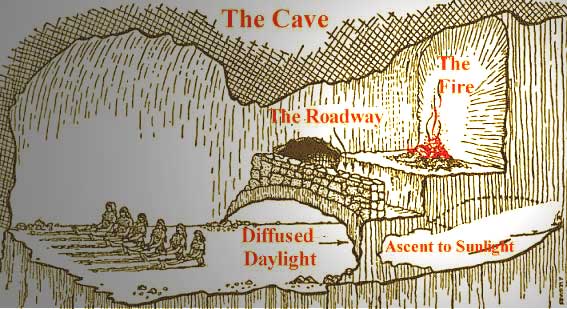
- Platos allegory of the cave is example of an ideological apparatus. It shows how what people are exposed to can shape what they believe to be reality.
Aaliyah Gravesande – Discussion Board 3.1
- I understand ideology is how you politically identify. It is a set of beliefs of how someone views the world. Many people share similar views which helps separate their ideologies. These views can be influenced by our families, communities, education, experiences, religion, the media, and the society we grow up in. For example Plato’s Allegory of the Cave shows how people can accept the beliefs they grow up around as reality, even if there may be more to understand beyond what they have always known.
- The differences I see between liberals and conservatives are how they view government, equality, and individual freedom. Liberals usually believe the government should be more involved in helping people and creating more equal opportunities. Conservatives usually believe in personal responsibility and traditional values. A good example is healthcare. Liberals are more likely to support government funded healthcare for everyone, while conservatives are more likely to prefer less government involvement and more individual responsibility.
- I understand Althusser’s definition of ideology as the ideas and beliefs we learn from society that shape how we see the world, often without us realizing it. Those around us, religion, and even media can influence what we believe is normal. This goes back to my example on Plato’s Allegory of the Cave, what we are exposed to can shape our understanding of reality.