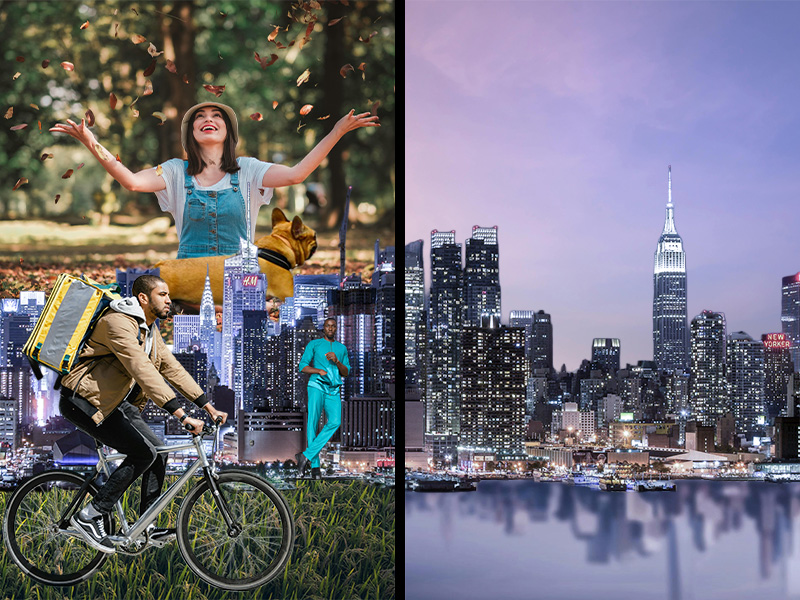
Your image project will be to create three versions of a collage or composite image. This post and our class disucssion are designed to help you understand these types of images so that you can choose your subject matter for your project.
Collage Image
- Definition: A collage image is a visual composition created by assembling multiple, often disparate, elements—photographs, illustrations, text, textures, or other materials—onto a single surface or digital layer. Traditionally created using physical materials adhered to a backing, collage can also be digitally produced by layering and combining images within software like Photoshop. The emphasis in a collage is often on the juxtaposition of these elements to create a new, unified whole that conveys a particular meaning, mood, or aesthetic.
- Key Characteristics:
- Assemblage: Primarily defined by the combination of distinct elements.
- Juxtaposition: Elements are often placed in unexpected or contrasting relationships. These relationships and the impression they leave on the viewer are often key to why the technique is used.
- Unified Whole: Despite disparate parts, the final image aims for a sense of coherence.
- Historically Significant: Rooted in 20th-century art movements (Cubism, Surrealism, Pop Art).
This video is about a show “Multiplicity: Blackness in Contemporary American Collage” that appeared in the Phillips Collection in Washington D.C. in 2024.
Composite Image
- Definition: A composite image is a photograph or digital artwork created by digitally combining multiple photographs or image elements into a single, unified scene. Unlike a collage, which often emphasizes the distinctness of its components, a composite image strives for a seamless integration of its elements, often with the goal of creating a realistic or fantastical scene that could not be captured in a single photograph.
- Key Characteristics:
- Integration: Elements are blended to appear as a cohesive scene.
- Realism/Fantasy: Often aims to create a believable or imaginative scenario.
- Seamlessness: Attention is given to lighting, perspective, and color matching to minimize visual cues revealing the image’s construction.
- Modern Technique: Frequently used in advertising, photo manipulation, and digital art.
This video shows photographer Jeff Chien-Hsing Liao who combines multiple photos of a location into one photo in a realistic way.
Distinguishing the Terms
A collage can be a composite, but a composite isn’t necessarily a collage. The key difference lies in the intent and the visual outcome. In a collage the individual elements are important and their placement together says something new. In a composite image the goal is to hide the different origins of the image and create a new image that looks like it was an original. The differences in the images and when you use the terms can be subtle. More important than whether you get it “right” every time is that you think about the image, the meaning it’s meant to convey and your methods of making it.

Leave a Reply
You must be logged in to post a comment.