Describe how you understand ideology

Edwin Castano

1. Keeping in mind the material covered in this lesson, describe how you understand ideology in your own words.

Hint: One way to approach this is as follows

a) Describe what ideology is in a brief paragraph (in your own words).

Ideologies are split into three groups right, center, and left. The right is made up of conservatives and corporate elites. They think people should be self reliant and that poverty is a result of personal choices. They want to protect businesses. The middle tends to accept capitalism but prefers reforms to focus on inequality and poverty. They support public services and regulations, but also back military spending and globalization. The left are progressives and socialists. They favor social democracy and public ownership. Fight for fair wages, healthcare, and education for all. Left typically does not believe in capitalism. They want the government involved to protect the public.

b) Give an example illustrating what you wrote in (a).

Progressive movements in 2025 continue advocating for social democracy and public ownership. Some US. States have a progressive tax system that provides relief for low-income families while increasing taxes on corporations, This shows a commitment to fairness and social services.

c) Write another paragraph (or two), explaining to your reader with additional details, how you understand ideology.

Progressives and socialists fight for the rights of workers, believing in the need for a society where public ownership and social democracy ensure equality. Similar to a union that supports fair wages, accessible healthcare and access to education for everyone. They don’t believe anyone should be left behind due to their socio-economic status.

2. How do you understand the difference between conservative and liberal ideology in US politics? What seem to be the big differences, the dividing line? Given an example to backup your arguments.

Hint: try to identify key words (concepts) that play a big role in making someone consider themselves to be liberal or conservative. Then, explain in your own words what those keywords (concepts) mean.

Liberals support a larger government role like social safety nets for individuals, progressive taxation, environmental protection, and public health. All to create a fair society.

Conservatives value limited government interference and traditional values, a free market economy, and lower taxes. They value individual responsibility and think poverty is a personal choice.

3. How do you understand Althusser’s definition of ideology? Paraphrase it in your own words. Given an example. Hint: you may have to watch the second video again, and find the few places where Althusser’s position is presented.

Althusser argued that ideology functions to maintain the power of the ruling class by reinforcing the social order. He believed individuals willingly accept the dominant ideologies of their society. He had the belief that schools, churches, media, and families all held their own values and beliefs that upheld the structure of society. He argued that ideology functions to maintain the power of the ruling class by reinforcing the social order.
3.1

. What is ideology?

Ideology refers to the combination of beliefs and values and ideas which determine how people understand the world and how they believe society should operate. Our understanding of normality and common sense is shaped by this concept which operates beneath the surface of our thinking processes.

The concept that success arises from effort constitutes an element of the American Dream ideology. This concept is widely accepted by society although it fails to account for the way systemic inequalities between racial groups and economic disparities prevent social mobility.

I view ideology as a mental framework. People view reality through the ideological perspective beyond mere political beliefs. Voting patterns as well as judgments about others and self-perceptions receive direction from this perspective. The challenging aspect is that people normally fail to recognize their worldview operates as an ideology because they perceive it as an objective fact of reality. Ideology functions as a double-edged tool since it provides power to its adherents but simultaneously conceals unfair systems by presenting them as inevitable natural phenomena.

  1. Conservative vs. Liberal Ideology in U.S. Politics

The fundamental principles of conservative ideology include tradition preservation alongside minimal government intervention together with personal accountability and free market systems. The core principles of liberal ideology emphasize equality alongside social justice while also advocating for economic government intervention and civil rights protection.

The main difference exists in government functions. People who identify as conservatives generally advocate for a minimal state which should refrain from interfering with personal choices and business operations. The main approach of liberals involves utilizing government power to address social disparities while safeguarding marginalized groups.

The healthcare debate demonstrates this point explicitly. People who identify as conservatives reject government healthcare systems because they believe these programs restrict personal freedom while raising taxes. The majority of liberals endorse the Affordable Care Act because they believe healthcare should be available to all people as a basic human right and that government involvement ensures this access.

Key concepts:

Freedom (for conservatives): means freedom from government interference.

Equality (for liberals): means creating conditions that help level the playing field.

Tradition vs. Progress: conservatives often value established norms; liberals often push for change.

  1. Althusser’s Definition of Ideology (Paraphrased)

According to Althusser ideology functions as a comprehensive framework which supports existing power dynamics. The belief formation process under this system leads people to accept their societal position without resistance. According to Althusser ideology performs “interpellation” by using a method that identifies individuals with specific social roles such as worker or student or citizen without their ability to doubt these designations.

Students in school learn to follow rules and show respect for authority while working to achieve grades as rewards. The educational system prepares students to follow workplace rules and execute instructions from their superiors. The system seems unbiased but it functions as an ideological framework because it trains people to adopt capitalist structures.

According to Althusser ideology exists beyond individual thoughts because it is embedded within institutional frameworks which include educational facilities and An error occurred while processing your request. Please try again.

Mardochee Jean-Discussion board 3.1

  1. To me, ideology is a deep-rooted and often unconscious system of beliefs, values, and assumptions that acts as a lens that allows an individual or group to make sense of what is happening in their everyday existence. More than a random collection of opinions, ideology is a coherent system of ideas that not only tells us what is true, right, or desirable, but also influences our understanding of social realities, affects what we do, and ultimately shapes our expectations for the future. For example, someone who has developed a strong ideology around “individual responsibility” would be likely to see unemployment as an example of a personal failure to put enough effort (instead of as an issue related to the economy), and thus demonstrates how ideology shapes the lens through which we view societal realities.
  2. At the heart of the divide between conservative and liberal worldviews in American politics is their view of government and public (versus) private liberty/equality: The conservative worldview tends to emphasize individual responsibility, with the belief that it maximizes freedom and prosperity, and characterizes the governmental system as limited, based primarily on private (often economic benefits) and traditional values. The liberal worldview tends to be more progressive with respect to government, typically advocating for government solutions to economic/institutional social injustices/injustices, prioritizing collective/equal well-being over individual liberty, advocating for government interventions for this purpose. Talking about the example of healthcare, a conservative might support private, market-based, and individuals have choices , while a liberal may support universal access to healthcare systems or major government interventions (and equity over free choice)
  3. Althusser’s definition of ideology reveals that it is not just an ideological apparatus, but instead a pervasive system that shapes how we unconsciously relate to our real conditions of existence primarily by “interpellation” or “hailing” of individuals as certain types of “subjects” in the social structure which acts to confer is identity and legitimacy. This can happen through “Ideological State Apparatuses” (ISAs) such as schools and families, that aspire to values, lead individuals to voluntarily engage in defined socializations and behaviors that reproduce the existing social order. For example, the ideology of “meritocracy” in education serves to interpellate students into belief, they are the architects of their success, allowing them to accept their social positionality is just and, therefore, natural rather than questioning the systemic inequalities of their context.

discussion board 3.1

Q1 answer: ideology is a form of social conditioning & status quo that shapes and molds peoples beliefs, perceptions, and attitudes towards specific circumstances and ideas that they typically don’t consciously consider or realize is in place. Primarily the way it’s structured gives into the fed belief that it is for the better and for proper functioning of said system. For example from birth you are told to obey your parents and to listen to everything they say because they know what’s best for you. however this isn’t the case for every person as many people have irresponsible, ignorant, power struggle dynamics with their parents that misdirect & excerise control has a means of power instead of care for their kids. But if a kid falls out of line they will be punished. This can mean physical punishment where a child is powerless to defend themselves. This could also mean taking away certain freedoms like social time and extracurricular activities. As I understand ideology it’s what upholds certain illusions of choice within our society. It is conditioning that we operate off of to continuously strengthen a certain system in place. I also understand it purposely is strenuous to break from. There are systems in place designed to instill fear and control over those who rebel. Many of the systems are orchestrated by large social structures. An example of a social structure that instills fear is religion. Many people fear going against god because of their relationship that starts at home with seemingly authoritative figures. If you go against them you get punished. So to be punished eternally by a unseeable force that will, and has the highest power to grant you “ sovereignty” if you follow its rules, is more capable of making you submissible, than fearing a temporary punishment here on earth. This fear that you begin to internalize is a central element of the systems utilization of control. If you have fear you can be controlled by it. So if you fear god you will fear going against the rules “god” has set for you. You will not question the authority and you will not go against it either.

Q2 answer: the difference between liberal and conservative politics is generally government intervention vs governed independence. liberals believe in government intervention for regulations, and taxes. as well as ensuring that their freedoms of speech, expression, and choice are protected just to name a few. where as conservatives believe in patriotism, traditional beliefs and values, less regulations on taxes, more military funding( patriotism), and protecting their traditional american lifestyle and ideology that everyone should be living by and following( in their words) , living united so to speak under those norms.

Q3 answer: Althusser wanted to understand what made people go against their own interest. and he stated that there is repressive and ideological apparatuses in place. repressive meaning enforcing control through a form of fear. and ideological apparatus meaning enforcing a mental condition into people through social institutions.

Najah Pointer Overview of Ideologies

  1. I see ideology as a set of beliefs, values, and principles that shape how people interpret the world, and deem how society should work. They influence things such as government policies, social norms, and even personal choices. Ideologies provide a sense of direction and it helps shape opinions on injustices, rights, and authority. At its core, ideology is a way of organizing thoughts on how life should be lived, and the way power should be used.
  2. I understand the difference between liberal and conservative ideology in it being rooted in how either side views the role of the government, individual freedoms, and social change. The dividing line mainly comes down to government Intervention, social values, and cultural identity. Conservatives generally lean toward a more limited government, relying on personal responsibility while liberals are in support of a more active government. When it comes to social issues, conservatives tend to prioritize traditional views (i.e; strict abortion and immigration laws) while liberals are in support of progressive views (reproductive rights, LGBTQIIA+ rights, and diversity.)
  3. Althusser defines ideology as a system of beliefs, ideas, and representations that shape how people experience the world, often without knowing its impact. He argues that it isn’t just a stream of thoughts but a primary driving force embedded in social institutions like school, church, and the media. Althusser seems to look at ideology as an active force that creates individuals who see themselves as freely choosing their beliefs, even when those same beliefs are derived from social structures.

Ideology in Politics – Daniel Reyes

  1. What is Ideology?

Ideology, to me, is how a person thinks of themselves and others, and the physical and social environment that they live in, and how those aspects shape their views. A person is subject to being shaped by how they view their environment, just as much as how they view the people around them. If they like the people around them, they are more than likely to adopt and share views with them. The opposite is true if they dislike the people or environment around them.

An example of this would be how children shape their views as they grow up. If they are fond of their parents and have respect for them, and their parents agree with conservative views, the child is likely to adopt those views. If a child does not respect their conservative minded parents, they may choose to have different or even opposite views.

I also understand ideology as a way for people to express themselves and their beliefs. As the second video states, ideology is one whole and, in our case, a means for society to keep in line with how capitalism functions. So, when we adopt certain ideologies, it is a way for people in society to express how they think by structuring their thoughts within the different ideologies accepted in our society (left, right, center). Although, some people in society can structure their thoughts around ideologies that would be deemed unacceptable in a capitalist society, like communism.

2. How are conservative and liberal ideologies different?

Conservative and liberal ideologies are mainly different by how they believe the size of our federal government should be and their outreach. Conservatives think that the government will obstruct an individual’s liberty and get in the way of the free market performing to its maximum capabilities in order to provide the best opportunities to individuals. They then believe the federal government should be small and the majority of government should be run by the state and local governments. They would prefer decisions on public education, health care, environmental protections be left up to smaller government structures or even left to the private sector. Liberals see the federal government as a way to helps solve issues in the public and private sectors. They believe the government can keep firms in check and protect society from firms abusing their power that they have attain through production and capital by enforcing regulations. This stems from the idea that the free market will not be fair to everyone. Liberals also advocate for a more progressive tax system, and that enough tax dollars are spent on National Defense. They would prefer that more tax dollars flow into subsidizing public education, healthcare, and housing.

3. How do you understand Althusser’s definition of ideology?

I understand Althusser’s definition of ideology as it being a means to get society in line with how it is supposed to function based on its type of economy, (capitalist, communist, socialist, etc.). Ideology is said, by Althusser, to be a whole system, with both the repressive and ideological apparatus in play to give you the illusion of choice or face the consequences. The consequences would be enacted through forced restrictions by the police, courts, and prisons, in order to keep society from revolting.

Jeniffer Garcia- Learning about ideology

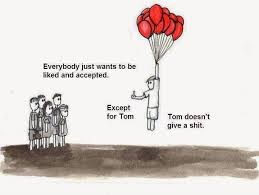
  1. Ideology in my own words is how someone thinks and their opinions on certain topics. You form your own ideology from what is around you, for example your parents, school, friends, all have an influence on you and you yourself make your beliefs from what is around you.And you may not always agree on what is said which can cause arguments and make you feel different and guilty for not agreeing. Two forms of ideology that is well known today is political and conservative ideology. In conclusion many people today believe in their own ideology and don’t seem to care about what others have to say or what they might think. This image above is an example of ideology showing that many people now try to fit in instead of standing for what they believe in.This makes others not have an opinion and they will always have in mind on how other perceive them. On the other hand we can see that in the image Tom is doing something differently and doesn’t care about what others might think.Your beliefs matter more because it shows who you are as a person.

  2. A way I understand ideology is by viewing it politically. Democrats are liberal and believe the government is helpful. While the republicans are conservatives and feel that the government is a threat. I think the main difference about both ideology is that liberal ideology is the peoples input meaning they are a part of a decision, while conservative ideology is following what has worked and not being part of a decision. An example is thats democrats advocate for the civil rights of minorities, provide social welfare programs, including Medicaid and food aid.
  3. The way I understand Althussers definition of ideology is that it’s a system to follow. For example the education system, they have been following the same teaching since centuries ago. It teaches us discipline and how to follow orders.

Jesus Catarino – Understanding Ideology

1)Describe how you understand ideology in your own words.

A) Well ideology in my own words in my own words and my understanding is that ideology is like a structure of a bunch of ideas and beliefs or opinions of one person or a group and how it influences peoples or groups point of view of this world we live in and our opinions towards it, for example communism and capitalisms also helping us understand the culture or society based on those ideas or beliefs that those certain individuals or groups have towards those topics how they view them, but ideologies can be wide range, people like us tend to follow some ideology because it can give us a sense of identity or a way of life or path, it gives us a vision of how things should look like gives us different solutions to problems, but it can also divide people who have a different viewpoint on how things should be in their vision that being beliefs reinforcing specific power structures.

B) Give an example illustrating what you wrote in (A).

For example Communism and Capitalisms during the Cold War Communism(Soviet Union)(USSR) and Capitalism(United States) both of this groups had different ideologies which are Communism and Capitalism so their point of view of the world, beliefs, solutions and opinions are completely different like their Economic System, Individual rights, Social class and the Role of the Government and how all of those ideas influenced people’s daily lives during those times.

C) Write another paragraph (or two), explaining to your reader with additional details, how you understand ideology.

Okay so they are a list of ideologies and each of them have their own viewpoint on how things should be by proposing solution towards problems which may be different to what another group or individual may belief in and that can cause problems from both sides with completely opposite goals, values, solutions and practices and we as people how a choice if you want to follow a type of ideology that you might connect with or identify with you and those beliefs on how something should be like a guide for how we should act, Ideologies can bring people together with common set of beliefs which can unite groups but can also divide us.

2) How do you understand the difference between conservative and liberal ideology in US politics? What seem to be the big differences, the dividing line? Given an example to backup your arguments.

The Difference between Conservative and Liberal ideologies would be the social issues, values, economic policy and government role, The core beliefs, conservatism would be limited government and individual responsibility and Liberalism would go for larger government. The Big difference would be the role of the government, conservatives believe the government should be smaller focusing in individual freedom and liberals are comfortable with the government addressing their issues the values of culture and the values of social like religious values and economic policy but it all comes down to the role of the government. An example would be Gun control conservatives believe in the second amendment the right to bear arms which lets law abiding citizens the right to own and carry a firearm, liberals have gun control laws which has background check restrictions on assault weapons this is aimed to reduce gun violence and protecting the public, the debate on gun control divides the conservatives and the liberals.

 3)How do you understand Althusser’s definition of ideology? Paraphrase it in your own words. Given an example

How I understand Althusser’s definition of ideology is that it’s not just a collections of ideas and beliefs but a system of practices that shapes us as individuals on how we see our selves and the world, for example schools, religion and the media which shapes how we see ourselves and the world guiding our behavior and identity and the actions we take, an example could be the education system schools not only teaching us math, English but also teach us some social values like respecting authority like for example teachers or school staff following rules those types of things also getting good grades so you can become successful in the future, shaping us in a way for future roles in society.

Juan Garcia Figueroa- Politics Ideology

1.
a)Describe what ideology is in a brief paragraph (in your own words)

= Ideology is when your believes are build by external factors like your parents and systems that determine the way you must think and act and also shows you the consequences of not following the rules and what is supposed to be accepted socially so that create our way of thinking and even build our personality


b) Give an example illustrating what you wrote in

= For example the ideology of what is ‘polite’ and the ways you should act or look to meet those expectations whether it is a meeting or when you need to show respect to those who socially are ‘above you’.

c) Write another paragraph (or two), explaining to your reader with additional details, how you understand ideology

= I understand ideology as the base of our behave and personality, if we would have been raised by other people besides the ones that raised us, or in another culture and so, our ideology and the way we perceive things, would we completely different so ideology is based on what we were and are exposed to, also in our adulthood we can change those ideologies if our view gets influenced by other factors in our daily lives.

2. How do you understand the difference between conservative and liberal ideology in US politics? What seem to be the big differences, the dividing line? Given an example to backup your arguments.
Hint: try to identify key words (concepts) that play a big role in making someone consider themselves to be liberal or conservative. Then, explain in your own words what those keywords (concepts) mean.

= The main difference between both is the way they think government should intervene in the society, i understand it as ‘The one who is worried about the working class (liberals) and the one who is worried about the profit and private sector (conservative)’ also the liberal one cares about the environment which i consider the most important thing to be aware of. For example rich people tend to be conservative because that party is what benefits them the most while marginalized people tend to support liberals because they believe in equality

3. How do you understand Althusser’s definition of ideology? Paraphrase it in your own words. Given an example. Hint: you may have to watch the second video again, and find the few places where Althusser’s position is presented.

=According to Althusser’s ideology there are two ways ideology rises, one is the repressive way where people face punishments when not following the rules (fear) and they need to follow strict and monotone rules established by the superiors for example the laws, if not followed people can face punishments and so on…. the second one is the ideological and this one has more to do with the way you are raised and what ideas you get from your guardians and their culture or just by the surroundings (people, thoughts, ideas, school…), for example in school rules have to be followed, a schedule, a specific way to behave..

Discussion Board 3.1


So, we’ve encountered three different overviews of what ideology is, but let’s organize our own thinking about it. In this discussion board, think about and comment on the following questions:

1. Keeping in mind the material covered in this lesson, describe how you understand ideology in your own words.
Hint: One way to approach this is as follows
a) Describe what ideology is in a brief paragraph (in your own words).
b) Give an example illustrating what you wrote in (a).
c) Write another paragraph (or two), explaining to your reader with additional details, how you understand ideology.

2. How do you understand the difference between conservative and liberal ideology in US politics? What seem to be the big differences, the dividing line? Given an example to backup your arguments.
Hint: try to identify key words (concepts) that play a big role in making someone consider themselves to be liberal or conservative. Then, explain in your own words what those keywords (concepts) mean.

3. How do you understand Althusser’s definition of ideology? Paraphrase it in your own words. Given an example. Hint: you may have to watch the second video again, and find the few places where Althusser’s position is presented.

Hint: Remember, the discussion boards are crucial for us this semester, because they reproduce our in-class conversations. Try to be thorough and write more, rather than less. I will do the same, and make sure by the time we end our discussion, we have covered the key ideas on the module.


To organize things better, I have broken up our conversation into two parts. After finishing here, head over to Discussion Board 3 – part 2 .


Before posting, watch this video, which will show you how to post your answer to this discussion board:

NOTE: Once you’ve scheduled your post to be published on at midnight on Sunday, you can still go back and edit your post until then, if you want to rewrite and/or add to your post.

As a review, follow the following steps to submit your response:

  1. Click on the “+” button in the black bar at the top of the screen
  2. Type a title for the post (it should include your full name)
  3. Type your response
  4. On the right side, click on Categories: and check “Discussion 3.1”
  5. Important: On the right side, at the top: click on the date next to Publish, and enter your post date, which is this coming Sunday, at 11:59pm.
  6. Click Publish and you’re done.

What will happen next is your post will automatically be published by the OpenLab system on Sunday at midnight. The goal here is for all student posts to be published at the same deadline. After that point, you can begin reading each others’ posts, and you have to comment on at least one other student’s post.

Note: please make sure that you schedule your post to be published on Sunday, midnight, not before.