Weight management

You can be active and healthy at any size – https://www.niddk.nih.gov/health-information/weight-management/staying-active-at-any-size. Cultivating body positivity or body neutrality can lead to better health outcomes. Read more about Health at Every Size here https://wellbeing.jhu.edu/blog/2023/02/20/health-at-every-size/.

The medical community defines obesity as a Body Mass Index (BMI) of 30 or greater, while overweight is defined as a BMI of 25 to 29.9. Larger bodies have become more common in the United States in the last few decades. In population studies, obesity is a risk factor for heart disease, some types of cancer, osteoarthritis, sleep apnea and several other health conditions. Overweight when present with other factors like high cholesterol, high blood pressure, family history, or cigarette smoking, is also considered to be a risk. It’s important to note limitations of BMI when it comes to individual risk assessment – this is a measurement created for population studies and people should use caution when interpreting this measurement for their individual health. See another perspective on why BMI can be inaccurate here https://www.medicalnewstoday.com/articles/265215.

Image shows a human body and lists medical complications of obesity: sleep apnea, stroke, asthma, pulmonary blood clots, heart disease, diabetes, fatty liver, cancers, arthritis, gout.

Learn more about obesity by watching Part 1 of the documentary Weight of the Nation. All parts are available for free on Youtube.

BMI is one of measures of body composition, previously defined here. Body composition is defined as the relative proportion of fat mass to lean mass in the body. It is usually measured by percent body fat, but that can be hard to do day to day. So one approximate measure is BMI, which is a ratio of mass to height. This number does not truly give someone an indication of their fat percent and some groups of people tend to have under- or over-estimates of their body composition when using BMI (athletic people, older adults, people who are below a certain height and so on). You can calculate your BMI here – https://www.nhlbi.nih.gov/health/educational/lose_wt/BMI/bmicalc.htm. Another measure is waist circumference, because abdominal fat puts you at higher risk for health complications.

There are more accurate measures of body composition. Calipers can be used by fitness professionals to do a skin-fold measurement to determine body fat percentage with more precision. There are also scales and handheld tools that use bioelectrical impedence to estimate a percent body fat. Less accessible are things like full body tools like air pods, hydrostatic weighing (under water), or special X-rays.

Body fat consists of essential fat (what we need to function), and storage fat. There is a range of normal body fat – https://us.humankinetics.com/blogs/excerpt/normal-ranges-of-body-weight-and-body-fat.

In order to improve your body composition, consider these tips.

Improve your diet, but do it as a change to your habits. Usually when people think of diets, they think of short-term programs meant to lose pounds fast. However, while this can help people lose weight, most will not maintain that weight loss. Read the post titled How can you eat healthier? Take a look at some myths about weight management – https://www.niddk.nih.gov/health-information/weight-management/myths-nutrition-physical-activity.

Practice portion control. Portion sizes have increased in the last several decades. Looks at this Portion Distortion Quiz to see how much. Read about portion control here – https://www.niddk.nih.gov/health-information/weight-management/just-enough-food-portions.

Become more active in your life. You can start slowly, by walking more places or getting off the bus or subway one stop early. Increase activity levels, including strength training and flexibility, until you meet the recommended activity levels.

Website analysis extra credit assignment

Pick a health-related topic and find a website that explains it. Answer the following questions:
• Who sponsors/pays for the site, and what is their mission?
• Can you tell when the site was last updated and who was the author of the site (if any)?
• To what extent does the website distinguish between facts and opinions? Are there supporting documents or are there links to information on other sites?
• Does the site use understandable language?
• Is the website clear and easy to use/navigate? Is the information comprehensive?
• Is the information reputable, accurate, current, and interesting? Does it ask for any personal information? Can you tell how the information on the site is selected?
• Would you recommend this site to others and why?

Reliable health information

In order to make educated and wise decisions about healthcare and health products and services, we must be able to get good information. With the Internet, there has never been more freely available information. But not all of that information is correct. Nevertheless, most of us reach for Dr. Google when we have a health question. How can we get the best information out there?

First, you should be skeptical of news pieces about health, especially if it’s something that sounds too good to be true. Read more or listen here – https://www.wnycstudios.org/story/breaking-news-consumers-handbook-health-news-edition. In particular, look to multiple news sources, try to find the original research and not just news summaries, and learn about the information in a wider context of other health information.

As you read health information, ask yourself the following questions:

Who wrote/made this?
Is there evidence provided?
Does it come from a scientific study?
Is it recent?
Who funded it?

Here are a few more questions to consider: https://blogs.bmj.com/bjsm/2021/11/25/7-questions-to-identify-health-misinformation-in-digital-and-social-media-and-how-does-it-start/.

Second, you can always ask your doctor what source of health information they recommend. Nowadays, many doctor’s offices have a way for you to email your doctor for quick questions and answers, if you don’t have a face-to-face appointment coming up.

Third, look things up on search engines (which include Google, Bing and others), using these tips – https://blog.library.si.edu/blog/2013/09/20/5-tips-for-better-searching/. An important tip is to use search terms effectively. Try different search terms and synonyms, using AND, OR and NOT when searching, using parentheses for phrases, and so on. One important thing to note is that AI tools like ChatGPT and other large language models are not the same as search engines. They provide answers to your questions based on whether something sounds like natural speech, not based on accuracy.

Some fact checking resources include: PolitiFact Health Check, FactCheck.org SciCheck, and Snopes, which has a section on science and technology.

Health insurance

You may have had health insurance for a long time, you may be covered under your parents’ plan, you may get it through Medicaid or Medicare, or maybe you don’t have it. But what is health insurance?

Here are some of the more common terms you may find in your health insurance plan – https://www.cms.gov/CCIIO/Resources/Files/Downloads/uniform-glossary-final.pdf. Note especially that there are several terms that relate specifically to how much you pay and when.

Most of the time, if you can get a health insurance plan through your employer, that will be a better deal than getting it on your own. What should you look for when trying to select a plan? https://www.nerdwallet.com/article/health/choose-health-insurance. Consider a few things as well – do you have a known chronic condition? What is your budget for healthcare? Are you generally healthy and don’t visit the doctor often? What is your financial situation at any given moment?

You may be eligible for a plan through Medicaid or Medicare (if you are over 65 years of age).

You may also decide to shop for a plan through the marketplace established by the Affordable Care Act – the New York State marketplace is here. Some information for young adults and about the essential plan can be found on the site.

Healthcare costs in the US are very high, usually much too high for an individual to afford. This video explains some reasons why.

Prevention and wellness

One view of medical care is that if something is wrong, you can go to the doctor to get better. The medical definition of health is often just the absence of a particular disease.

However, there is another view of health and wellness – this is the view that sees wellness as a combination of several dimensions, and sees the interaction of the person and their environment. In this view, we not only want to cure an illness, we want to prevent it from happening if possible. This is the public health model of health.

We can think of prevention as a behavior that eliminates or lowers the chances that a disease will happen in the first place (primary), or behaviors that lead to a disease being discovered early and thus treated early (secondary).

Examples of primary prevention are vaccination, wearing condoms, putting on sunscreen and hand washing. Examples of secondary prevention are Pap smears, mammograms, and other screening tests.

Image of vaccine adminstration

Here are a few more ideas for preventing disease – https://www.nih.gov/health-information/disease-prevention-toolkit.

Complementary and Alternative practices

We already know the definition of conventional healthcare. Anything that falls outside the realm of conventional care is considered to be complementary or alternative care. You may also see the term integrative health. Read about the differences here – https://www.nccih.nih.gov/health/complementary-alternative-or-integrative-health-whats-in-a-name.

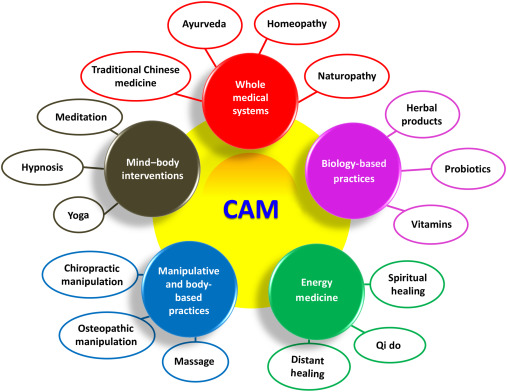
There are several types of complementary or CAM approaches.

Natural products includes various products like herbs, dietary supplements, probiotics and so on. These tend to be the most common CAM practices that people try.

Mind and body practices include things like yoga, meditation, massage, chiropractic practices and so on.

Some CAM practices can be considered their own medical system. Examples include Traditional Chinese Medicine, Ayurveda, homeopathy and others. These systems have their own philosophies about what causes health and disease, often incorporating a belief in some kind of vital force like qi, and will likely contain a large number of different types of treatments. These systems are often considered holistic, because they think of the person as inextricable linked to a vital force that connects them to the environment, and because the body, mind and spirit are closely connected.

Traditional Chinese Medicine includes practices like acupuncture, massage, herbal remedies, and several other components.

Ayurvedic medicine is one of the oldest systems of medicine still practiced in the world. It came from India and contains several practices like yoga, meditation, herbal and natural products, diet and so on.

Homeopathy is a holistic system which was developed in Germany about 200 years ago. Treatments mainly consist of highly diluted remedies.

Before you decide to use any of these practices, consider whether they are safe for you to use and whether they are effective – https://www.nccih.nih.gov/health/safety and https://www.nccih.nih.gov/health/are-you-considering-a-complementary-health-approach.

Make the most of your healthcare visit

You’ve decided to go see a doctor or other healthcare provider. Maybe it’s just time for a check-up. Maybe you are not feeling well. Whatever the reason, here are some ideas to make the most out of your visit.

Think about your reason for the visit, prepare ahead of time, try to focus on what brought you in – https://www.npr.org/2019/07/03/738497630/how-to-get-the-best-from-your-doctor. Before the visit, it’s important to know your own medical history, your family history, and collect a list of medications you are using day to day (including dietary supplements).

Learn how to ask questions! Sometimes the visits are short, and you forget to ask something you wanted to know about. Try to write down your questions before the visit so that doesn’t happen. Some sample questions are here – https://www.ahrq.gov/questions/10questions.html.

If you are nervous about something, it may be helpful to bring someone with you to the visit. Having two sets of ears can help you to remember some of the important things your doctor may tell you. You can also take notes during your visit, especially if you are getting a prescription, the doctor is sending you for a test or procedure, or they tell you something unfamiliar. Finally, you can ask for a printout or visit summary, or check the patient portal to see what happened during the visit.

As a patient, you have certain rights. In general, you have the right to get medical care if you need it, and to refuse specific kinds of care. You have the right to an informed decision – that is, your healthcare providers should tell you your diagnosis, the risks and benefits of possible treatments, and the success rate of a treatment if there is a known one. You have the right to privacy of your medical information and the right to view your medical records.

What makes a good doctor?

We all have to seek professional healthcare sometime. But how do we find a healthcare provider we really like and trust?

Think about a good experience you’ve had at the doctor’s office, urgent care, or hospital. What stood out to you as a good quality for your healthcare provider?

Think of a bad experience. What did you find frustrating? What would you change, if you could?

Building a relationship and trust with your healthcare provider can take time. Think of the first visit as a way to determine whether you might be a good fit. Observe the organization at the office and the communication style of people who work there. And after the appointment, reflect on how it went and what could have gone better. We all deserve a healthcare provider who will listen to us and help us, so if you are not satisfied, it is fine to look for someone else.

Find some more ideas here – https://www.npr.org/sections/health-shots/2019/07/08/739039046/how-to-pick-a-doctor-or-break-up-with-one.

Conventional medical care

Conventional medical and health care are also called allopathic or Western medicine. This is in contrast with complementary, alternative, or integrative health approaches. Most of the healthcare you have probably gotten in the United States is this type of care – the kind where doctors, nurses and other affiliated medical professionals provide the care.

This type of care generally concerns itself with diagnosing, preventing and treating disease. Disease or illness in this system of care is thought to happen because of organic changes in the body, like atherosclerosis, or from exposure to pathogens like bacteria and viruses.

The people who provide conventional care are medical doctors who hold MD or DO degrees, nurses (who may have a bachelor’s or master’s degree and who are licensed as RNs or NPs), physical therapists, and various other allied medical professionals. Examples include emergency medical technicians (EMTs), respiratory therapists, dentists, podiatrists, optometrists, and others.

Most medical doctors hold the MD (medical doctor) degree, and some may also have a DO or Doctor of Osteopathy degree. They attend accredited medical schools for several years, then have periods of residency and internship, and some may choose to specialize further. Doctors who provide general every-day medical care are usually those who studied internal medicine or family medicine. They may be known as general practitioners or primary care providers. They can see people for common complaints like respiratory infections, and well-care (check-ups that may include blood laboratories, blood pressure screenings, vaccines, and other prevention and routine care). They can order screening tests, blood work, medical imaging like X-rays or MRIs, and other diagnostic tools, and can prescribe medications. Doctors’ offices may also have Nurse Practitioners (NP) or Physician Assistants (PA) provide this kind of care under the supervision of the doctor.

Doctors who choose to specialize, spend several more years working in a particular area of medicine. This can be based on a particular body system, like cardiology or neurology, a kind of patient, like pediatrics or gynecology/obstetrics, or particular type of disease, like oncology (specializing in cancers). Usually, a primary care provider may refer their patient to a specialist if they require more than routine every-day care.

Conventional care is also found in hospitals, urgent care centers, and rehabilitation centers. Here, many allied health professionals may be present to help doctors provide care.

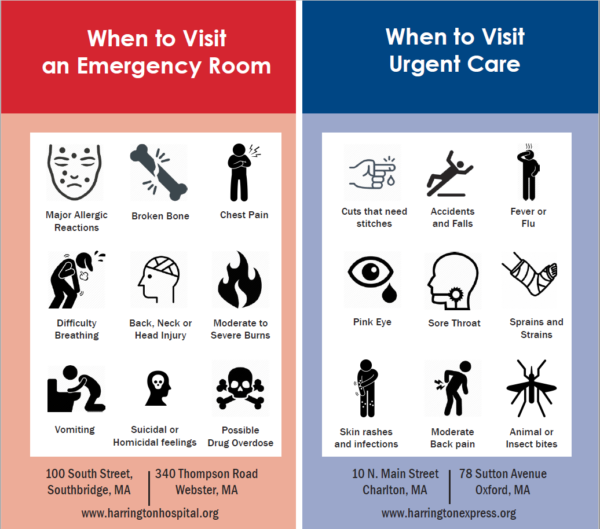
When should you seek emergency care and when should you go to an urgent care center? Generally, you should go to the emergency room for a life-threatening condition (heart attack), sudden serious changes like shortness of breath, numbness or paralysis, or serious/severe conditions like trauma, severe cuts or burns, severe allergic reactions and so on. Urgent care is for times when you need care right away and may not be able to see your primary provider quickly – things like respiratory infections, earaches, etc. Get your preventative care from your primary care provider.

Image that shows when to visit an emergency room and when to visit urgent care. For emergency room: major allergic reaction, broken bone, chest pain, difficulty breathing, back/neck/head injury, moderate to severe burns, vomiting, suicidal or homicidal feelings, possible drug overdose. For urgent care: cuts that need stitches, accidents and falls, fever or flu, pink eye, sore throat, sprains and strains, skin rashes and infections, moderate back pain, animal or insect bites.
Look for emergency rooms and urgent care centers that accept your insurance and are close to you.

Obesity trends in the U.S.

Obesity and overweight in the United States have been on the rise for many years. Remember, this is measured using BMI, which is a population measure. Be cautious when interpreting this number in your personal life. It is not always an accurate indicator of your body composition or your health.

Image of 3 maps of the US from 1990, 2000, 2010, showing obesity trends among US adults. The trend is that percentages of people classified as obese has increased in each state.
CDC.gov

Updated obesity facts in the US are here https://www.cdc.gov/obesity/adult-obesity-facts/index.html.

What are some reasons that people in the US have become more obese? What has changed in the past 20+ years? What are some individual and societal factors contributing to these trends?