

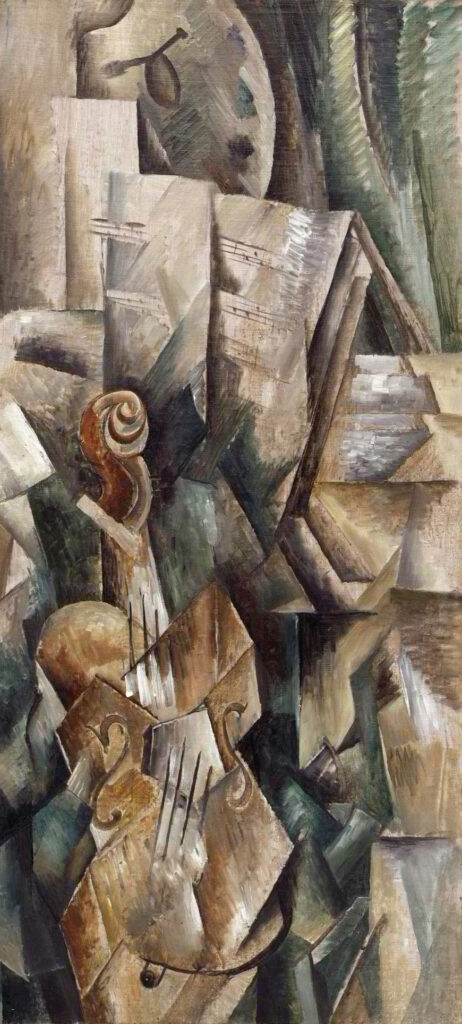
Violin and Palette, Georges Braque, 1909
By Anna Lozynska
In a similar way, the violin creates elegant yet powerful melodies; a painting of this musical instrument can evoke viewers’ emotions and produce music in their minds.
In Georges Braque’s painting Violin and Palette, by way of using geometric shapes and forms, the artist illustrates the beauty and elegance of the musical instrument that can evoke profound emotions. The body of the instrument has been broken up into geometric shapes; nevertheless, the artist includes S-shaped sound holes and the scroll at the top of the body. The strings of the instrument are broken in two parts by geometric figures, and the neck is shortened; however, no one will doubt that it is a violin. Braque used pastel colors including green, brown, black, grey, beige, and white. While depicting the violin at the bottom, Braque emphasizes its importance by using a darker palette around the instrument. Although the violin draws the main attention in this artwork, the artist illustrates it among the notes and probably other instruments that one can notice in the background.
Braque was born on May 13, 1882, in Argenteuil-sur-Seine, France. He moved to Paris in 1901, and after working on Impressionism and Fauvism, his works transitioned to the Cubist phase. Violin and Palette by Braque is a part of Analytic Cubism that evokes “breaking down” or “analysis” of form and space. The objects are still recognizable in paintings, but they are fractured into many facets, just like the surroundings with which they merge (Guggenheim Museum, n.d.).
Painted in 1909, Violin and Palette belongs to the first phase of Picasso’s and Braque’s joint endeavor to create a new approach to the pictorial representation of objects in space. From 1909 to 1912, both Picasso and Braque painted almost exclusively in a range of neutral tones before reintroducing color, largely using collage elements. Other Cubist painters often used bright colors, making the use of a limited palette one of the distinctive characteristics of Braque’s and Picasso’s Analytic Cubist paintings. Since the palette was restricted, the artist has used shading to indicate curves, which gives a tangible form and connects the abstract geometric patterns that dominate the painting. While constantly working on this style and continuing to develop, over the next few years, both artists’ approach to representation became increasingly abstract (Cramer & Grant, 2020).
The monochromatic tones and fractured space reflect not only Cubism’s aesthetic values but also its philosophical alignment with modernity, questioning linear perspective and single viewpoints. While Picasso and Braque did not provide any explanation of their Cubist work as some of the Salon Cubists did (Smarthistory, n.d.), Braque later explained that “When fragmented objects appeared in my painting around 1909, it was a way for me to get as close as possible to the object as painting allowed” (Vallier, 1954, p. 16).
At first glance, the painting appeared chaotic. However, the more one studies its forms and structure, the more recognizable its quiet elegance is. What initially seemed fragmented gradually revealed its order, and the placement of every shape and line began to make sense. Since music created by the violin evokes elegant but strong and passionate feelings, the painting of a violin gives such feelings as well. It does not need bright colors to reveal its significance. By depicting a violin with pages of music among the overlapping geometric shapes, the artist analogizes the painting to notes that blend into a melody.
References
• Cramer, C., & Grant, K. (2020, March 23). Georges Braque, Violin and Palette. Smarthistory. https://smarthistory.org/georges-braque-violin-and-palette/
• Guggenheim Museum. (n.d.). Violin and Palette. The Solomon R. Guggenheim Foundation. https://www.guggenheim.org/artwork/673
• Smarthistory. (n.d.). Salon Cubism. https://smarthistory.org/salon-cubism/
• Vallier, D. (1954). Braque: La peinture et nous, propos de l’artiste recueillis. Cahiers d’art, 29(1), 16.





