
By Mya Grace Louissaint
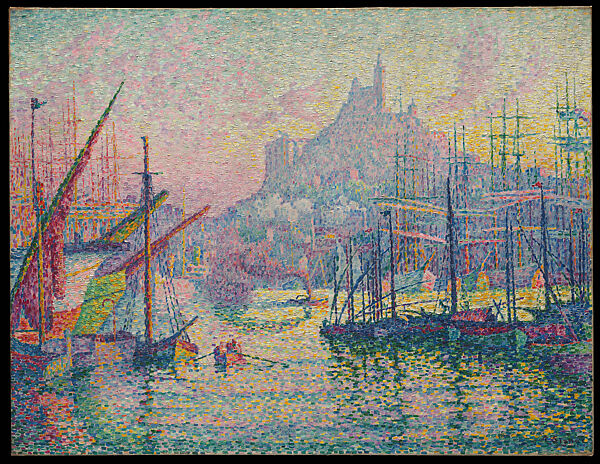
Paul Signac’s Notre-Dame de la Garde (La Bonne Mère), Marseille is an oil on canvas painting made in 1905–06. It is a beautiful piece that caught my eye as soon as I saw it. It is full of the most beautiful and vibrant colors, but at the same time, it is still at a low intensity and not as bright as you would think. Now, just looking at the painting, it seems to be very flat; however, there is a lot of texture in this painting. Looking at a picture, you would not be able to tell that the painting in real life has a lot of paint on it—so much so that some areas of paint are higher than others. He uses these constant short strokes with gusto to really help the viewer see just how much color he saw. The style is like that of a mosaic. That style also helps with the depth perception in the painting. If you look in the background, you can see a very colorful sky with puffs of clouds within it. You can see exactly where the sun is setting and how the hues are changing with it. You can also see the church “Notre-Dame de la Garde,” which was nicknamed the “Good Mother.” The church was built upon limestone as a structure on top of a big hill with many trees at its base. In the middle ground, Signac uses a delicate range of hues to create harmony between the sea, sky, and sunlight. You can see the sunlight reflecting on the water and ships in the port, and even a smaller boat just passing by, leaving a smoke trail. In the foreground, you can see multiple boats just lying idle in the water. Next to the boats, you see a rowboat heading toward the port. The sea in the foreground is also stunning because Signac is really representing all these different values within it. You can see the shadows of the boats in the reflection of the water and the reflection of the setting sun. The attention to detail is very incredible to see.
Signac incorporates many elements of art in his work. The line structure he uses clearly depicts many figures, such as boats, a hill, buildings, and the sea, and the sky meeting at the horizon line. There is value in the sky changing as the sun sets, going from cool to warm hues. Even the way the clouds are arranged makes me think it could have been windy. Everything he did in this painting makes me feel like I am there in the moment, watching the sun set and watching the ships be docked at the end of the day. You can see how vast the sea is and how great its depth is. Signac shows the viewer just how tall the hill is and how grand the church on top of it is, also showing the cluster of trees at the base of the hill, making a canopy of trees at different heights. The use of color and shape shows the viewer what time of day it is, as we can see a sunset and the reflection it has on the water. The texture of the painting is also very noticeable if you are looking at it in person. You can see all the layers of paint and how thick some areas are. The gusto helps emphasize the shimmer on the surface of the sea. Signac also paints lots of soft ripples in the sea, the shadows of the boats, and even the smoke from a moving boat. This suggests the blend of old and new—the steam meeting sail in an age of technological change. This much attention to detail and realism makes me feel like this painting is almost a live photo. I can almost smell the charcoal steam or taste the saltiness in the air, hear sailors yelling, and feel the wind on my face. It feels like I’m there in that moment. All these elements together help us understand the painting and get a glimpse into what it was like at this port in 1905.
I chose to look carefully at Paul Signac’s Notre-Dame de la Garde (La Bonne Mère), Marseille, because, like I said before, when I first viewed this painting, it took my breath away. I literally walked away and had to come back to really look at it some more. What I found most interesting about the painting is the way it was painted. The short, tile-like brushstrokes were a great way to really show just how much color there was. It was more effective than just doing an ombre of colors. I knew that it must have taken a lot of skill and time to get it to look like that with the technique he was using. I was also interested in the building on top of the hill and what those arches could be. Even the steamboat felt very significant, like this was a moment described in a story. At first, it just seemed like a colorful and beautiful seascape. I could see the water and the city in the background, and a pretty sky. But as I really took the time to look at the work, I noticed so much more. Learning about Signac’s Neo-Impressionist method and how he placed pure hues side by side to let the eye blend them together helped me appreciate his technical precision. He used the Pointillism technique, though at the time, he did not like calling it that. Everything I saw felt like an individual movement. This changed my impression a lot because I realized that this painting was unique. Also, at that time, I knew the Salon was very strict about their requirements, and I knew that this was probably something that was not appreciated at the time. But reading about Signac showed me that he was doing what he loved, as well as the other Impressionists. They wanted to focus on things they could see and experience. They were very interested in the different times of day to see how far the values of light could go. Signac wanted us to know what life was like for him. His everyday life was probably mundane, but he made it beautiful in his own way. The more time I spent looking and learning about the painting, the more I could tell that Signac painted not only what he saw but what he felt—a deep admiration for the sea, the boats, and the radiant color of modern life. The painting feels alive, as if the sun and wind move with the waves in the sea.
The painting Notre-Dame de la Garde (La Bonne Mère), Marseille is a Neo-Impressionist painting. Neo-Impressionism is a term coined at the last Impressionist exhibition in 1886 by the critic Félix Fénéon. Fénéon first used the term Neo-Impressionism to describe the paintings of Georges Seurat, Paul Signac, Camille Pissarro, and Pissarro’s son. It is used to describe the avant-garde art movement that became popular in France from 1886 to 1906. Artists of the Neo-Impressionist circle did not just paint with spontaneity like most Impressionists. They used a calculated painting technique founded in science and the study of optics. The Neo-Impressionists believed that multiple individual strokes of unmixed pigment resulted in a more vibrant color that viewers could see. This was called mélange optique, meaning optical mixture. The Neo-Impressionist artists felt that this way of painting made the light shimmer on the canvas. After learning that, I can see now that the painting wasn’t just random brushstrokes. The placement, technique, and color were all planned to make this piece cohesive and seem like it is moving. Paul Signac said, “The separated elements will be reconstituted into brilliantly colored lights,” meaning not mixing the colors on a palette and letting them be their own on the canvas will make the viewer’s eyes see the colors as brighter and blend them optically. All in all, this painting is a great depiction of Neo-Impressionism, and it also captures a moment of transition in both technology, with the steam-powered ships, and in art, as his Divisionism technique bridges Impressionism and modern color theory.
Cited work:
Metmuseum.org, 2021, www.metmuseum.org/art/collection/search/437672.
https://www.metmuseum.org/essays/georges-seurat-1859-1891-and-neo-impressionism