- The distinction that Reading 4.3 makes between owners and employees is that the owning class lives off stocks, bonds, rents, mineral royalties and other property incomes. Employees live off wages, salaries, and fees. Basically, “owners refer to giant corporations while employees are the workers. McDonalds, for example, is considered an owner while the employees, such as the cashier or cook, are the workers who depend on the salary while also keeping the value of the business.
- Smith believed the real value of anything comes from the work put into making it. It’s not about how much money something costs, but the effort and labor involved in its creation. The example he gives is how a tree transformed into furniture or paper gains its value not from its raw material, but from the effort invested. From the timber harvesting, the manufacturing process, and even the advertising used to sell it, the labor involved dictates its true price.
- When we let social class define us, it can be a heavy chain that limits our potential. Reading 4.4 suggests that class shouldn’t be tied to our identity, and I agree. If we separate social class from who we are, we open up space to thrive, regardless of our financial situation. This way, our true worth and identity aren’t defined by something that’s often beyond our control.
- In this argument, it suggests that in a capitalist system, class structures are built around a close form of dependency, where the working class and the owning class, or the capitalist class, are heavily reliant on each other for economic and social survival. This close form of dependency refers to the fact that the working class, consisting of workers and employees, heavily relies on the owning class for their livelihood, job security, and economic well-being. The first example that came to me was Amazon. Customers rely on their platform for convenient shopping, and workers (customer service, packers, drivers, etc.) heavily depend on Amazon for their jobs and income. Meanwhile, Jeff Bezos and shareholders reap profits without directly participating in production.
Social Class- Junice Ramirez
- Social class is often viewed as a hierarchy in society. It’s determined by factors like income and education. However, the economy is changing, making it harder for people in the middle class to earn a living and bridge the gap between classes. Education is still a key factor, but the disparity between the upper and middle classes is growing.
- Far Rockaway, near the A train, reflects a mix of working and lower classes, as seen in the socioeconomic divisions of the area. There’s a clear split between those on financial aid and those in a higher social class so this was not a surprise.
- Based on the Reading, and my personal experience being in NYC, I do notice a pattern in social classes. Higher classes seem to reside closer to the Manhattan and then as you expand out towards the boroughs it tends to go down. There are some areas that are being gentrified but for the most part it tends to be lower going towards Bronx, Brooklyn and Queens.
Junice Ramirez- Repressive vs Ideological State Apparatus
- The Repressive State Apparatus is a concept from Louis Althusser that describes how a government maintains control over its citizens through force. This includes institutions like the police, military, courts, and prisons. Althusser calls it “repressive” because it uses violence to silence opposition and maintain social order. The term “repressive” shows how the state depends on force to manage people, especially during times of crisis or strong disagreement. Basically, it is how the government uses power to maintain order and authority.
- Ideological State Apparatus prevents change to the status quo, including school, politics and mass media. For example, in politics, we’re given options that make us feel like we’re part of the decision-making process that effects the society we live. It keeps things the way they are by making us think we have a choice. Similarly, the media shows us many products to buy, but they’re often very similar. This makes us feel like we’re in control, but really, we’re just choosing from a limited set of options that don’t really challenge the system.
- The Repressive State Apparatus uses force and authority to control people (fear, law enforcement), while the Ideological State Apparatus uses ideas and persuasion (schools, media, politics). One relies on coercion, and the other relies on influence.
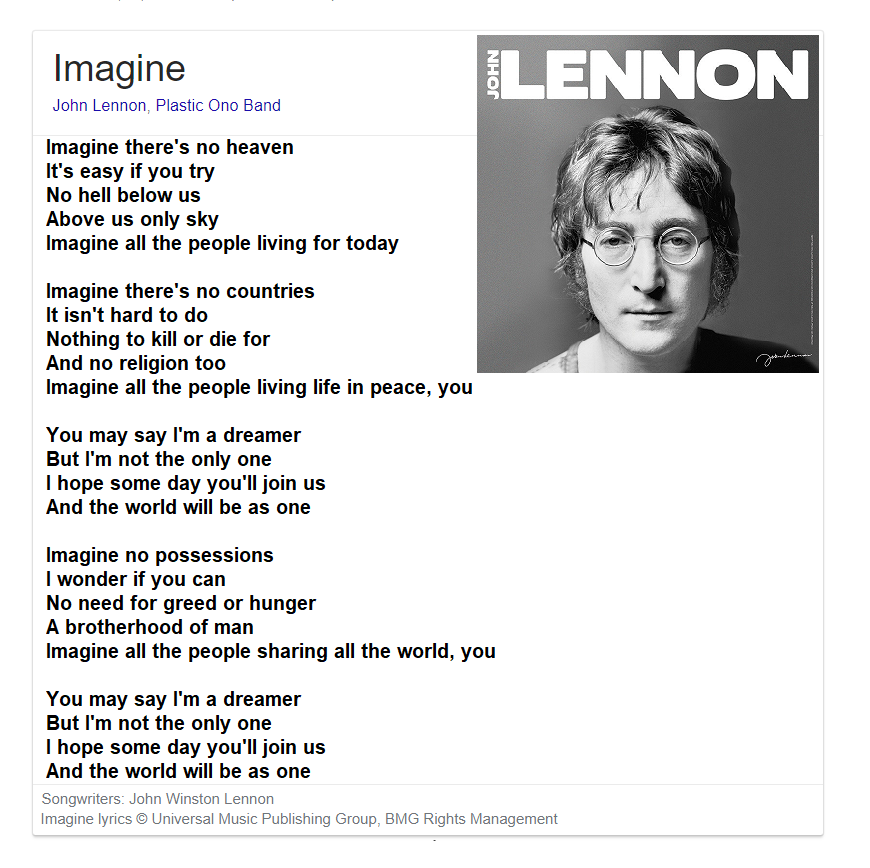
- Imagine by John Lennon is an ideological state apparatus because it’s shaping us to conform to the dominant ideology of world peace. For example, he invites us to imagine a world without war suggesting that peace is achievable if people share a collective dream for it. It promotes human unity and encourages people to vision a world where everyone lives as equals. The overall “Imagine” message embodies a hopeful perspective because it invites people to dream of a better world and consider their role in making it a reality.
Junice Ramirez – Defining Ideology
- Ideology is a collection of beliefs, values, and ideas that influences how people view the world and guides their actions and choices. It shapes the way we interpret social, political, and economic situations. Ideologies can take many forms, such as political views like liberalism, conservatism, or socialism. These frameworks help individuals understand their roles in society and how they relate to others. An example of ideology is consumerism. Advertisements create the illusion that we have endless choices and that we’re making the best decision by buying a particular product. This leads them to prioritize shopping and owning brand-name products. However, this “choice” is often an illusion, as it’s shaped by the ads and societal pressures. People feel like they’re making a free decision, but in reality, they’re being influenced to prioritize shopping and owning certain products. This ideology makes people think they’re in control, when actually, they’re following a predetermined path. My understanding of ideology is that it is more than just a set of beliefs; it is a way for people to make sense of the world around them. Ideologies help shape our identities and connect us with others who share similar values. They can motivate people to fight for social change, as seen in movements for civil rights, where the belief in equality unites individuals to challenge unfair systems. However, ideologies can also create division when groups become too rigid in their views.
- Conservative and liberal ideologies differ mainly in their views on government and society. Conservatives believe in a free market economy, where individuals have the freedom to make their own choices, and they think less government involvement helps businesses grow. They value personal responsibility and traditional values, often supporting a stronger defense. In contrast, liberals focus on social justice and equality, arguing that the government should play a bigger role in solving problems and helping people through social programs. The main difference between them is how much control they think the government should have: conservatives prefer less involvement, while liberals want more. For example, a conservative might oppose raising the minimum wage, believing it would hurt businesses, while a liberal would support it to help workers earn a fair living.
- According to Althusser, ideology functions by placing individuals within certain social structures and practices, making them feel connected to the larger system. It helps maintain the status quo by promoting ways of thinking that align with the interests of those in power, even if those ideas aren’t always in the best interests of individuals themselves. Althusser’s theory can be illustrated through the role of schools in shaping not only students’ academic knowledge but also their social values. From an early age, children learn important concepts like hard work and following rules, often through the guidance of authority figures such as parents and teachers. These figures establish a framework of constructive feedback that helps kids understand expected behaviors and avoid serious consequences later in life. This process reflects how those in power view society’s future, as education serves to mold individuals in ways that maintain the existing social order.
Wealth Inequality- Junice Ramirez
- The statistic that made the biggest impression on me was that 90% of American families have little to no assets. This figure is striking because it emphasizes the reality that a vast majority of people are living paycheck to paycheck, struggling to meet basic needs. It shows the financial instability that many face, trapped in a cycle of poverty and unable to save or invest for the future.
- Living in a society with big wealth gaps can make it tough for people to move up economically. Opportunities, like good schools or healthcare, are usually available only to the wealthy. You can see this in the neighborhoods around us. Rich areas have way better resources, while poorer communities struggle to get what they need. Also, education shows this inequality, as wealthy families can put their kids in private schools with better resources, while kids in lower-income areas often go to underfunded public schools.
Wealth of Capitalist- Junice Ramirez
The M-C-M diagram represents how capitalists build and increase their wealth. It starts with M (Money), where capitalists use their initial funds to invest. They then purchase C (Commodities), which can include raw materials, labor, and machinery needed for production. Once the goods or services are created, they are sold, resulting in M’ (More Money), where profits are generated from selling these products at a higher price than the costs incurred.
This cycle enables capitalists to continuously reinvest their profits, allowing for further growth and accumulation of wealth. A significant aspect of this system is that workers are often paid less than the value of what they produce, creating surplus value that contributes to the profits of the capitalists.


