DB 5.2 April Gonzalez

Respond to the following question: Explain M-C-M’ to show how capitalists maintain and increase their wealth.

A capitalist remains wealthy by using the formula M-C-M’. The wealthy person already has money (M), that they possess from previous wealth or earnings which they use to purchase commodities (C) that are necessary for production, such as buildings, tools, raw materials, equipment, and labor power. Labor power is the most crucial commodity because it is what creates new value. Workers sell their labor in exchange for wages, but their work generates more value than what they are paid. After purchasing the means of production and labor, the capitalist then produces a product and sells or resells it for a value greater than the cost of production. This sale returns more money to the capitalist than they initially invested, and this increase in money is (M’)—the surplus value.

Most of the capitalist’s profit comes from surplus value, which is the unpaid labor from workers. This surplus labor is the additional time workers work after they have already earned their wages during part of their shift. Therefore, capitalists maintain and increase their wealth by exploiting the working class. As society progresses, the constant capital (such as raw materials and equipment) remains largely the same, but it is the variable capital—the wages paid to workers—that ultimately increases the capitalist’s wealth and surplus.

DB 5.1 April Gonzalez


  1. The way I understand means of production are the instruments it takes to produce something which includes ones skills, talents, and or what one owns. For example I use my building zoning code knowledge, typing skills, a computer and copy machine to prepare specific forms and applications to process my work permits. Labor can increase the value of what you have as labor is measured in the time it takes to complete producing the product under normal circumstances. Example How much time I actually apply to do the task (under normal conditions), the more time spent the more it is worth. Time is literally money.
  2. Another important concept in understanding social class is value. Based on the ideas presented in Video 5.1, what is value?  What give “value” to value, what makes something valuable? Labor and value are intrinsically connected. The amount of labor time spent on producing a good or service determines its value. The more time and effort involved in production, the more valuable the product becomes. For instance, hand-made goods take more time to create than machine-made ones, so they are often priced higher because more labor is involved in making them.
  3. How are labor and value related? What’s the relationship/connection between the two? Labor and value are related due to the amount of time and effort it takes to create goods or service. The more time it takes to make something the higher its value. Like when something is handmaid rather than machine made it takes more time and can cost more.
  4. How do you understand the difference between labor and labor power? Hint: this is a key difference, give it your best shot based on what the video says about it, and your own ideas. We’ll clarify and develop it in our discussions, and in my video comments. Labor is the actual work or effort put into creating something, whereas labor power is the potential or capacity to perform labor. Labor power is what individuals sell to employers in exchange for wages. It is sustained by the basic needs like food, clothing, and shelter, and it is the source of the actual labor effort. In essence, labor power is the “capacity to work” that someone offers, while labor is the actual performance of that work.
  5. Surplus value refers to the additional value generated by workers beyond the cost of their labor. In other words, after workers are paid their wages, the value they create in excess of their wage is retained by the employer as profit. It’s crucial for understanding capitalism because it reveals how workers are often paid less than the value they create, which leads to inequality and class conflict. For example, if an employer pays workers $10 for an hour of labor but charges customers $30 for the product, the $20 difference is surplus value—profit that goes to the employer rather than the workers.


DB 4.2 by April Gonzalez

1. What is the distinction that Reading 4.3 makes between owners and employees? Give an example of each.

The distinction between owners and employees is that the owning class (or capital class) lives off the work produced by their employees. They don’t depend on a salary; instead, they earn profits from their assets, which include investments like real estate, stocks and bonds, rare minerals, and land. In contrast, employees (or the labor class) need to work for a living and rely on a salary.


2. How do you understand the quote by Adam Smith on page 28? What is it saying about labor?

I interpret Adam Smith’s quote, “labor… is alone the ultimate and real standard by which the value of commodities can at all times and places be estimated and compared. It is their real price; money is their nominal price,” to align with Abraham Lincoln’s idea that “Labor is prior to, and independent of, capital. Capital is only the fruit of labor, and could never have existed if labor had not first existed. Labor is the superior of capital, and deserves much the higher consideration.” Essentially, it means that labor—the work done by people—has true value, whereas money is just a symbolic measure. The working class is more valuable because they do the actual work.


3. What are your thoughts on the main argument of Reading 4.4 that class is NOT an identity?

My view is that liberals miss an important point: class is not just a separate identity, but a relationship of interdependence. Unlike the independence that characterizes other aspects of identity (like race or gender), the classes rely on each other. Capitalists depend on workers for production, and workers depend on capitalists for wages. Liberals’ way of thinking about class as a ladder and viewing it as more quantitative than qualitative complicates their efforts to address oppression, especially when fighting for racial and gender equality. This approach makes it harder to fully tackle the underlying issues of exploitation.


4. How do you understand the argument Reading 4.4 makes when stating that “class structures are built around a close form of dependency”? What is this close form of dependency, and can you think of an example?

The close form of dependency means that both the capitalist and the worker rely on each other. Capitalists depend on workers for production to generate profits and satisfy investors. On the other hand, workers depend on capitalists for a paycheck to support their families. An example of this is a labor strike: if workers stop working, there are no products for the capitalists to sell. But without the capitalists, workers have no jobs, no salary, and no way to feed their families. This creates a mutual dependency that is central to class structures.

4.1 by April Gonzalez

1. Do you notice any similarities in the way social class is discussed in Readings 4.1 and 4.2? Do you notice any differences in how these two readings differentiate between social classes?

I’m a little confused because I can’t access the 4.2 reading, so I’m comparing Reading 4.1 with the readings in the 4.3 section.

The similarities I noticed between the way social class is discussed in Reading 4.1 and Section 4.3 are that both readings recognize that social class is determined by the amount and type of property one owns, and that positions in the social hierarchy are not fixed for life.

The difference lies in how the two readings define or differentiate the classes. In Reading 4.1, social class is determined by a wide range of factors and can vary significantly, with five typical social classes. People may not always recognize or agree on which class they belong to, even though they measure themselves using the same criteria. The value of these criteria, however, differs depending on perspective. In Section 4.3, the distinction between the two main social classes (the owning class and the labor class) is more straightforward. If you own wealth in the form of investments, real estate, stocks, bonds, or natural resources, you belong to the owning class. If not, you are part of the labor class, working for a living and earning a salary.


2. Pick the station closest to where you live. On the M train at Fresh Pond Road, using the concepts from Reading 4.1, what social class tends to live in your neighborhood?

Middle and working class.

Are you surprised (or not) by the answer?

Not surprised.

Do you feel it is an accurate representation of the people living in your neighborhood?

Yes, it is an accurate representation of the people living there.


3. Based on Reading 4.2, do you notice a general pattern about social classes in NYC?

From my experience, social classes in NYC tend to be separated into different neighborhoods, largely due to the cost of living, property values, and local job opportunities. For example, you’ll find two completely different classes living side by side but not interacting. In some areas, there are public housing projects, like Queens bridge Housing, which provide affordable housing for the lower class. Nearby, there may be warehouse manufacturing districts and commercial areas that create structural barriers between the lower-class neighborhoods and wealthier areas. A prime example of this is Long Island City, where luxury condominiums for the upper class are located next to office buildings, creating a clear divide between these wealthy residents and the lower-income neighborhoods just a short distance away.

Ideology by April Gonzalez

1. Keeping in mind the material covered in this lesson, describe how you understand ideology in your own words.

Ideology to me is a person or group of persons own ideas or personal view of what to them is right or wrong, the beliefs they hold about the world around them that usually pertains to political theory and policy and is usually swayed by economic conditions. For example my personal ideology is that everyone should have equal rights and that our taxed dollars should be used in governmental assistant programs like universal healthcare and less used on military defense spending. With those ideologies I am considered a left leaning either liberal, democrat or progressive even though I consider myself independent.

2. How do you understand the difference between conservative and liberal ideology in US politics? What seem to be the big differences, the dividing line? Given an example to backup your arguments.
These days it really doesn’t seem that there exist the typical conservative party as this day in age MAGA republicans in my opinion are not conservative at all. Yet a conservative once upon a time believed in less government involvement, less taxes and conservative spending. Most conservatives are white Christians that believe in prayers in school and loose gun laws. The conservative party differs from the liberal ideology as liberals believe that the wealthiest should pay more in taxes literally just their fare share as sometimes they pay nothing, they believe in stricter gun laws and that government should be stepping in to regulate the greedy large corporations to protect the environment and ensure equality for all just to name a few.

Republicans have created more government involvement in our personal lives than ever. They tell kids what they can read by banning books, they create new agencies like DOGE, use religion to control the masses by implementing laws to take women’s reproductive rights away and LGBTQ rights to marry or seek gender affirming care away. They preach about fiscal spending yet add 8 Trillion dollars to the deficit more than any even 2 term president in history. They preach christian values yet so many are riddled by sex scandals and corruption. They use to be originalists and swore by the constitution now they break the rules to force their white supremacist agenda.

3. How do you understand Althusser’s definition of ideology? Paraphrase it in your own words. Given an example.

Louis Althusser a Marxist philosopher’s definition of ideology can be understood as a set of beliefs or ideas that help maintain the existing social and political order, particularly by supporting the interests of the ruling class. He believes in shaping people’s beliefs, values, and perceptions in a way that reinforces the status quo, using fear to ensure that the dominant social order remains intact. In this view, the ruling class controls the masses by creating ideologies that convince them to act against their own interests, often without realizing it.

For example, in capitalist societies, the wealthy elite may perpetuate the idea that immigrants are the reason for job loss among the working class. This distracts from the real issue: corporations outsourcing jobs or hiring immigrants for lower wages. As a result, the working class vote for politicians whose policies benefit the wealthy (such as opposing better healthcare or wage increases) while blaming immigrants for their struggles. Eventually, these policies can have negative consequences for everyone, such as rising food prices or labor shortages, as the focus shifts away from addressing the real causes of economic inequality.

Ideology pt 2 by: April Gonzalez

1.What is a Repressive State Apparatus? Why does Althusser call it “repressive”? Can we explain his choice of words here. Give an example.  

Repressive state apparatus are a collection of state controlled institutions that use force or threats of force to maintain order and enforce the rule of law, control us through the threat of violence. For example courts, prisons, police precincts, cops judges are all examples.

2. Let’s do the same for the Ideological State Apparatuses. What are they, how do they seem to work?

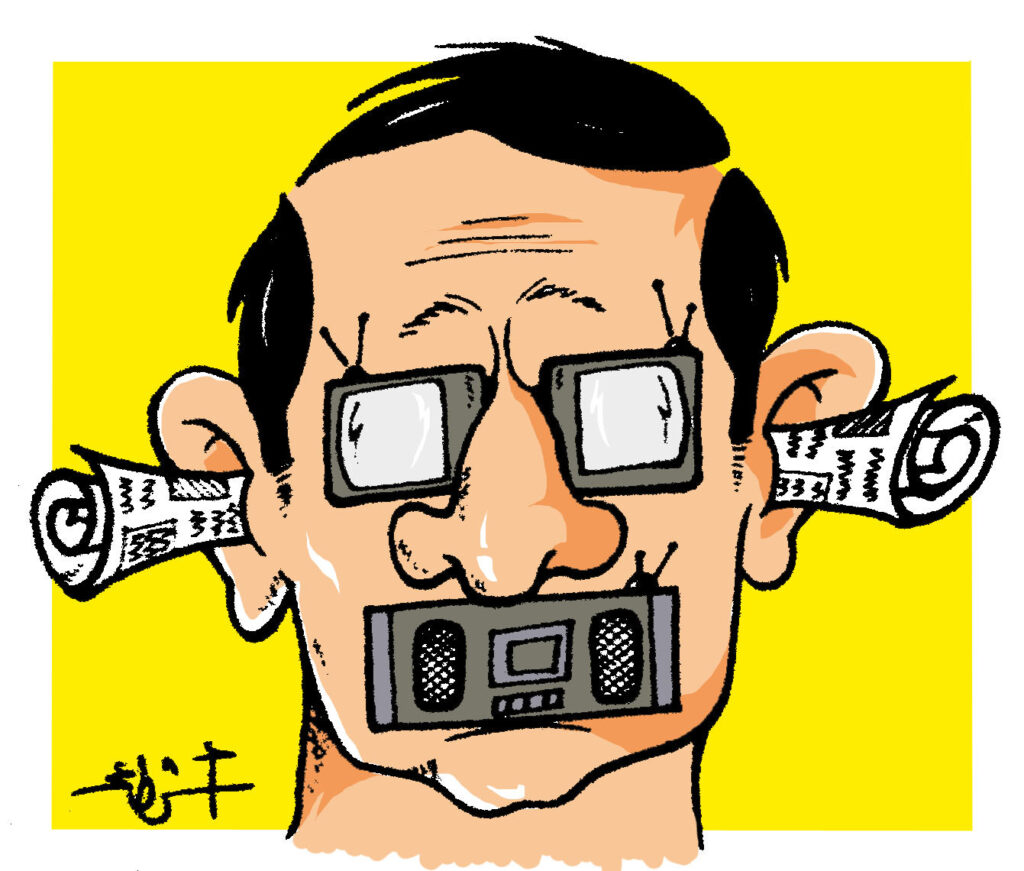
Ideological State apparatus are institutions that prevent change to the status quo by indoctrinating us by priming and distraction. For example Schools, politics, and mass media. Their purpose to keep us in line with giving us the illusion we have a choice in order to settle our revolutionary impulses.

3. Important: this question will appear on our exam: How are the Repressive and Ideological State Apparatuses different from each other? What is the difference between the two?

The difference in the two are the techniques they use to control the masses. While repressive state apparatus is ruling by threat of consequence like use of physical force, incarceration and obvious to its function and purpose, Ideological state apparatus is more covert, it’s like subliminal mind control that we aren’t consciously aware is even happening.  

4. Post an example of ideology. This could be a piece of writing, an image, video, pdf document, visual art, or music, clip from a movie. Next to your example, specify if this is an example of repressive or ideological apparatuses at work.

Ideological apparatus