
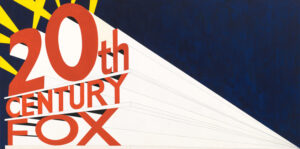
Large Trademark with Eight Spotlights, Edward Ruscha, 1962
By, Mauricio Farias
In Large Trademark with Eight Spotlights, Edward Ruscha takes the famous 20th Century Fox logo and makes it feel huge and important. The sharp, clean lines and geometric shapes of the letters make them look bold and strong. The bright golden-yellow letters stand out against a deep blue sky, and the way he uses light and shadow makes the spotlights look like they are glowing for real. The paint is so smooth there are no visible brushstrokes, which makes it look more like a polished sign than a traditional painting. All these details make the artwork feel big, dramatic, and connected to Hollywood’s flashy style.
These elements make the artwork feel more like a big Hollywood sign than a regular painting, which connects it to pop culture and advertising. It impacts my understanding of the work by showing just how enormous and attention-grabbing it is. It’s everything pop culture and Hollywood represent—the lights, the big bold letters—all demanding to be seen. What I find most interesting about this work is how it connects to something I’ve loved since I was younger, movies. I was always drawn to film and even wanted to be a movie critic. My first impression of the painting was how big and bold it looked, almost like I was actually in a theater. It instantly reminded me of watching trailers before the movie starts, which has always been one of my favorite parts of going to the movies. Seeing the familiar logo in such a large, dramatic way gives me a sense of comfort, almost like home, and it makes me realize how powerful images from pop culture can be in shaping our memories and feelings. When I was growing up, one of my fondest memories was arriving in New York and my mom putting on Home Alone for me. I’ll never forget that feeling. Large Trademark with Eight Spotlights gives me that same sense of familiarity—it connects to the movies I grew up with, like Star Wars. Looking at it almost makes me feel like I’m 7 years old again, experiencing all that excitement and wonder for the first time.
Large Trademark with Eight Spotlights feels like more than just a painting to me, it is a direct connection to pop culture and the way Hollywood shaped so much of American identity. Ruscha took something as familiar as the 20th Century Fox logo and placed it in the world of fine art, blurring the line between advertising, design, and traditional painting. It is bold, bright, and instantly recognizable, showing that images from movies and mass media can carry just as much cultural value as classic subjects in art. Ruscha “painted the production logo of 20th Century Fox, its letters and numerals appearing to be projected from the picture’s bottom right corner” (Farago). This direct pull from Hollywood imagery turns the painting into both an artwork and a cultural time capsule.
When I look at this piece, I also see a bigger picture of America in the 1960s. A time when art was breaking away from tradition and embracing the imagery people saw in their daily lives. Ruscha was not just making Pop Art, he was studying how language, images, and media shape the way we think. By painting this giant logo with sharp, clean lines, golden yellow letters, and that deep blue Hollywood sky, he captures the spectacle and ambition that Hollywood has always represented. It is more than just a logo, it is a snapshot of a culture that thrives on big dreams, bright lights, and the promise of something larger than life.
Works Cited
“Edward Ruscha | Large Trademark with Eight Spotlights, 1962.” Whitney Museum of American Art, Whitney Museum of American Art, collection page, https://whitney.org/collection/works/886.
“Edward Ruscha, Large Trademark with Eight Spotlights, 1962.” Whitney Museum of American Art, Whitney Museum of American Art, 26 June 2025, https://whitney.org/media/63023.
Farago, Jason. “Ed Ruscha, a Master of Words, Pictures and the American Scene.” The New York Times, 7 September 2023, https://www.nytimes.com/2023/09/07/arts/design/ed-ruscha-retrospective-moma.html.